Cross Encoder
On this page
Level: Intermediate · Reading time: 8 min · Phase: 2 — Advanced RAG
In one line: A cross-encoder is a model that reads the question and a document together and outputs one relevance score for that pair.
Before you start: Reranking. You should know that a second pass re-orders the candidates a fast search returned.
Explain it like I'm new
Imagine two ways to judge whether a key fits a lock. Way one: photograph every key once, photograph the lock, and compare photos. Fast, and you can photograph all keys in advance. Way two: actually put each key into the lock and turn it. Slow, but much more accurate, because you test how the two interact.
A cross-encoder is way two. An encoder is a neural network (usually a transformer like BERT) that turns text into numbers. "Cross" means the question and the document are fed in as one combined input, so every word of the question can pay attention (look at and weigh) every word of the document. The model can notice things like "the question asks about cancelling and refunds, and this passage covers both".
Words to know:
- Encoder: a neural network that turns text into numbers.
- Transformer: the kind of neural network (BERT is one) that lets words look at each other.
- Attention: how the model weighs which other words matter for each word.
- Forward pass: one run of the model on one input.
- Token: a small piece of text, roughly a word or part of a word, that the model reads.
- Sigmoid: a function that squashes any number into the range 0 to 1.
The output is a single number, often between 0 and 1 after a sigmoid, meaning "how relevant is this document to this question". There is no reusable vector for the document. That is the price: you must run the model again for every new question.
Watch it
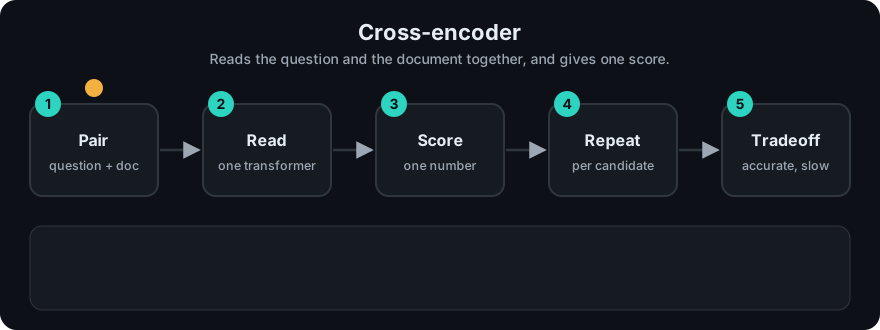
It plays on a loop. Read the caption in the box, one step at a time. Want to go at your own pace? Step through it with Previous and Next.
How it works
- Join the texts:
[CLS] question [SEP] document [SEP].[CLS]and[SEP]are special marker tokens. - Run the joined text through the transformer. Attention flows across both parts.
- A small layer on top of the
[CLS]output produces one score. - Repeat for every candidate document. Sort by score.
           ┌──────────────────────────────────────────┐
question ─▶│                                          │
           │   Transformer (full cross-attention)     │──▶ score 0.91
document ─▶│                                          │
           └──────────────────────────────────────────┘
        one forward pass PER (question, document) pair
Worked example
Question: "How do I cancel my subscription and get a refund?" Two candidates from the demo corpus:
| Candidate text | What the pair check sees | Toy score |
|---|---|---|
| "Refund refund refund. Refund policy. Refund rules." | Covers only the "refund" part of the question; no "cancel" | 0.2 |
| "To cancel your subscription open Settings... A refund for the unused month is issued..." | Covers cancel, subscription and refund | 0.6667 |
These are the real numbers from cross_score in the code below. Each score needed the question and the document together, so nothing could be computed for the documents in advance. With 2 candidates that is 2 model runs; with 50 candidates it is 50.
Cost example: 1 question × 50 candidates = 50 forward passes. 1 question × 10 million documents = 10 million passes. That is why cross-encoders are used for reranking a shortlist, not for searching a whole corpus.
Cross-encoders are trained on labelled pairs, for example MS MARCO, a large dataset of real search queries with passages marked relevant. The model learns to push relevant pairs up and irrelevant ones down.
Code example
A real cross-encoder learns its features. This stdlib toy from adv_rerank.py hand-writes two pair features to show the idea that the score depends on both texts at once:
def cross_score(query, doc):
    q, d = tokens(query), tokens(doc)
    if not q or not d:
        return 0.0
    coverage = len(set(q) & set(d)) / len(set(q))          # how much of the question is answered
    q_bi, d_bi = set(zip(q, q[1:])), set(zip(d, d[1:]))
    phrase = len(q_bi & d_bi) / len(q_bi) if q_bi else 0.0  # word order matches
    return round(0.8 * coverage + 0.2 * phrase, 4)
Notice there is no embed(doc) you could store. The score is computed from the pair.
In real projects with sentence-transformers:
from sentence_transformers import CrossEncoder

reranker = CrossEncoder("cross-encoder/ms-marco-MiniLM-L-6-v2")
pairs = [("How do I reset my password?", text) for text in candidate_texts]
scores = reranker.predict(pairs)  # one float per pair
When to use it / when not to
- Use it as the second stage after a bi-encoder or BM25 retriever.
- Use it when small wording differences matter (legal, medical, support FAQs).
- Don't use it as your only retriever over a large corpus. It does not scale.
- Don't use it when you cannot afford extra latency or GPU cost per query.
| Cross-encoder | Bi-encoder | |
|---|---|---|
| Input | (query, doc) together | query and doc separately |
| Pre-compute docs? | No | Yes |
| Accuracy | Higher | Lower |
| Speed at query time | Slow, per pair | Fast, one query embedding + vector search |
Common mistakes
- Feeding documents longer than the model's maximum input length (often 512 tokens). The end gets truncated, and the answer may be in the end.
- Comparing raw scores across different cross-encoder models. Score scales differ; only the ranking within one model is meaningful.
- Using a model trained on web search for a very different domain without checking it on your own eval set.
- Scoring one pair at a time instead of in batches, which wastes the GPU.
Recap
If you remember only three things:
- A cross-encoder reads the question and one document together and returns one relevance score.
- It is more accurate than a bi-encoder but must run once per pair, so it only suits a shortlist.
- Scores from different models are not comparable; only the ranking inside one model means something.
Interview questions
1. Why is a cross-encoder more accurate than a bi-encoder? <details><summary>Answer</summary> Because query and document tokens attend to each other inside the model, it can model fine-grained interactions (negation, which entity does what, whether all parts of the question are covered). A bi-encoder compresses each text into one vector independently, losing that interaction. </details>
2. Can you cache cross-encoder results? <details><summary>Answer</summary> Only per exact (query, document) pair. You can cache scores for repeated popular queries, but you cannot pre-compute document representations the way you do with a bi-encoder. </details>
3. How would you pick k (candidates) and n (kept) for a reranking setup? <details><summary>Answer</summary> Measure. Raise k until first-stage recall@k stops improving or latency becomes unacceptable; choose n based on the context budget and answer quality on a golden set. Typical starting points are k=20–100 and n=3–8. </details>
Go deeper
- Passage Re-ranking with BERT
- Sentence-BERT paper (compares bi- and cross-encoders)
- Sentence-Transformers documentation
Prev: Reranking · Next: Bi Encoder · Back to phase: Phase 2