Self Attention
On this page
Level: Intermediate · Reading time: 10 min · Phase: 3 · LLM Concepts
In one line: Self-attention lets each token build its new meaning as a weighted average of all the tokens in the same sentence, with weights based on how relevant each one is.
Before you start: Transformer Architecture. For a slower, step-by-step walk through Q, K and V, see Q, K and V Explained From Scratch.
Words to know:
- Vector: a list of numbers, here standing for one token.
- Dot product: multiply two vectors position by position and add the results. A bigger answer means the vectors point in a more similar direction.
- Softmax: turns a list of scores into positive weights that add up to 1.
- Weighted average: a blend where some items count more than others.
- Causal mask: a rule that stops a token from looking at tokens that come after it.
- Matrix: a table of numbers. Multiplying a vector by a learned matrix produces a new vector.
Explain it like I'm new
Think of a library search. You walk in with a question ("books about rivers"). Every book has a label on its spine. You compare your question to each label, and the better the match, the more of that book you read. What you walk out with is a blend of the books' contents, weighted by match.
Self-attention does exactly this for every token:
- Query (Q): what this token is looking for.
- Key (K): what each token offers, used for matching.
- Value (V): the information each token actually passes along.
"Self" means the queries, keys, and values all come from the same sequence. In real models, Q, K, and V are produced by multiplying each token's vector by three learned weight matrices (W_q, W_k, W_v). Training adjusts these matrices so useful words attend to each other, for example "it" attending to the noun it refers to.
Watch it
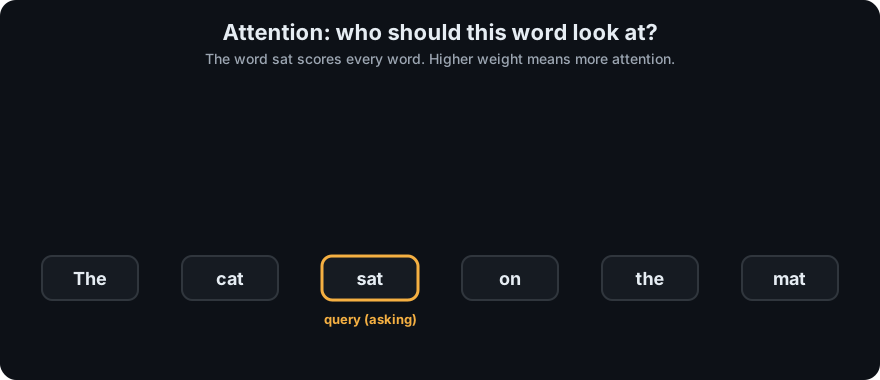
It plays on a loop. Read the caption in the box, one step at a time. Want to go at your own pace? Step through it with Previous and Next.
How it works
The formula from Attention Is All You Need:
Attention(Q, K, V) = softmax( Q · Kᵀ / sqrt(d_k) ) · V- Score. Dot product of each query with each key gives an
n × ntable of raw scores. A higher dot product means "more similar". - Scale. Divide by
sqrt(d_k)(the key size). Without this, scores grow with vector size, softmax becomes nearly one-hot, and gradients shrink. - Mask (optional). Add
-infwhere a token must not look, such as future tokens in a decoder (a causal mask). After softmax those weights become 0. - Softmax each row so the weights are positive and sum to 1.
- Mix. Multiply the weights by V. Each output row is a weighted average of value vectors.
         keys:  k1    k2    k3
query q1  ->  [0.51  0.19  0.31]   row sums to 1
query q2  ->  [0.19  0.51  0.31]
query q3  ->  [0.27  0.27  0.45]
output_i = sum_j  weight[i][j] * v_j
Worked example
One query q = [1, 0], two keys k1 = [1, 0], k2 = [0, 1], values v1 = [10, 0], v2 = [0, 10].
- Scores:
q·k1 = 1,q·k2 = 0. Scale bysqrt(2) ≈ 1.414:[0.707, 0]. - Softmax:
e^0.707 ≈ 2.03,e^0 = 1, so weights≈ [0.67, 0.33]. - Output:
0.67·[10,0] + 0.33·[0,10] = [6.7, 3.3]. The query "leans" toward the value whose key matched.
Read it as a story: the query [1, 0] asks "who is like me?" Key 1 is identical to it, key 2 is unrelated, so token 1 gets about two thirds of the attention. The output is a blend that is mostly value 1 with a bit of value 2.
The test test_attention_hand_computed_example in test_llm_attention.py checks this exact number.
Code example
import math

def softmax(row):
    m = max(row)
    e = [math.exp(x - m) for x in row]
    return [v / sum(e) for v in e]

def attention(Q, K, V):
    d_k = len(K[0])
    out = []
    for q in Q:
        scores = [sum(a * b for a, b in zip(q, k)) / math.sqrt(d_k) for k in K]
        w = softmax(scores)
        out.append([sum(w[j] * V[j][c] for j in range(len(V))) for c in range(len(V[0]))])
    return out

print(attention([[1, 0]], [[1, 0], [0, 1]], [[10, 0], [0, 10]]))  # [[6.69..., 3.30...]]
The full version with masks lives in llm_attention.py: run python 03-llm-concepts/code/llm_attention.py.
In real projects (PyTorch 2.x has a fused, fast kernel):
import torch
import torch.nn.functional as F

q = k = v = torch.randn(1, 3, 4)  # (batch, tokens, features)
out = F.scaled_dot_product_attention(q, k, v, is_causal=True)
When to use it / when not to
- Self-attention is the default way to mix information across tokens in modern models.
- Cost is
O(n²)in time and memory forntokens. For very long inputs, people use tricks such as sliding-window attention, KV caching, and fused kernels (for example FlashAttention). - For tiny fixed-size inputs, a plain MLP may be enough.
| Term | Shape for n tokens, width d |
|---|---|
| Q, K, V | n × d_k (or d_v) |
| Score table | n × n |
| Output | n × d_v |
Common mistakes
- Forgetting to scale by
sqrt(d_k). Training becomes unstable. - Applying softmax over the wrong axis. Each query row must sum to 1.
- Masking by setting scores to 0 instead of
-inf. A score of 0 still gets weight after softmax. - Mixing up attention weights with "explanations". Weights hint at information flow but are not proof of reasoning.
Recap
If you remember only three things:
- Each token makes a query, and compares it to every token's key to get scores.
- Softmax turns the scores into weights, and the output is the weighted average of the value vectors.
- Divide by
sqrt(d_k)to keep scores tame, and use-inf(not 0) to mask tokens that must not be seen.
Interview questions
1. Why divide by sqrt(d_k)? <details><summary>Answer</summary> Dot products of random vectors grow in size with dimension. Large scores push softmax into regions where one weight is near 1 and the gradient is near 0. Scaling keeps the scores in a range where softmax still learns. </details>
2. What is the time complexity of self-attention, and why? <details><summary>Answer</summary> O(n² · d): every one of n queries is compared with every one of n keys, each comparison costing d operations. Memory for the score table is O(n²). </details>
3. What is the difference between self-attention and cross-attention? <details><summary>Answer</summary> In self-attention Q, K, and V all come from the same sequence. In cross-attention the queries come from one sequence (for example the decoder) and the keys and values from another (the encoder output). </details>
Go deeper
- Attention Is All You Need (Vaswani et al., 2017)
- Neural Machine Translation by Jointly Learning to Align and Translate (Bahdanau et al., 2014), the earlier attention idea
Prev: Transformer Architecture · Next: Multi Head Attention · Back to phase: Phase 3