Tokenization
On this page
Level: Beginner · Reading time: 8 min · Phase: 1 — RAG Foundations
In one line: Tokenization is splitting text into small units called tokens (words or word pieces) that a model can turn into numbers.
Before you start: Embeddings. You should know that models work on numbers (vectors), not on raw text.
Explain it like I'm new
Think of LEGO. You cannot ship a built castle through a narrow tube, but you can ship the bricks and rebuild it. Models cannot read raw text. They read a sequence of brick IDs. A tokenizer breaks text into bricks (tokens) and maps each to an integer ID from a fixed vocabulary.
Tokens are often not whole words. Common words like "the" are one token. Rare words get split: "tokenization" might become "token" + "ization". This method is called subword tokenization. It keeps the vocabulary manageable (tens of thousands of entries) while still handling any word, including typos and new names.
Why should a RAG engineer care?
- Limits are in tokens, not characters. Embedding models and LLMs have maximum input sizes measured in tokens.
- Cost is in tokens. API pricing counts input and output tokens.
- Chunk size is best set in tokens, so chunks fit the embedding model.
A rough rule for English text with common tokenizers is about 4 characters per token, but code, numbers and other languages differ a lot. Always measure with the real tokenizer.
Words to know:
- Token: one small unit of text (a word or part of a word) that the model sees as a single item.
- Tokenizer: the tool that splits text into tokens and maps each one to an ID.
- Vocabulary: the fixed list of all tokens a model knows, each with an integer ID.
- Subword: a piece of a word, such as "ization".
- Corpus: the big collection of text used to train or build something.
- Context window: the maximum number of tokens a model can take in at once.
Watch it
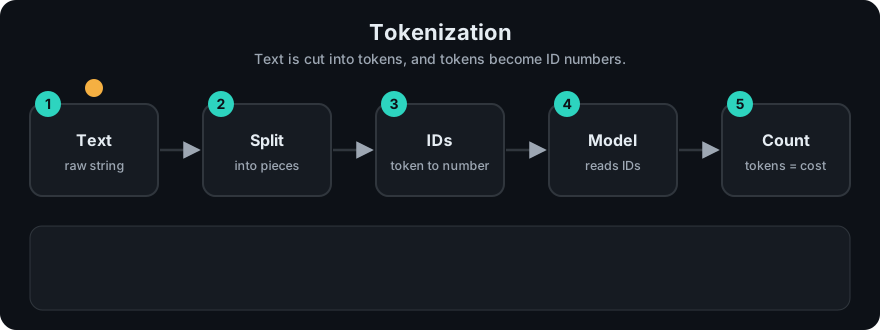
It plays on a loop. Read the caption in the box, one step at a time. Want to go at your own pace? Step through it with Previous and Next.
How it works
Most modern models use Byte-Pair Encoding (BPE) or a close relative (WordPiece, Unigram). BPE learns its vocabulary by repeatedly merging the pair of symbols that appears together most often.
- Start with single characters (or bytes) as the vocabulary.
- Count which pair of neighbouring symbols appears most often in a big training corpus.
- Merge that pair into a new symbol and add it to the vocabulary.
- Repeat until the vocabulary reaches the target size.
- To tokenize new text, apply the learned merges in order.
"lower lowest"   start:   l o w e r _ l o w e s t
merge (l,o)  ->  lo w e r _ lo w e s t
merge (lo,w) ->  low e r _ low e s t
merge (e,r)  ->  low er _ low e s t
tokens:          [low][er] [low][e][s][t]  -> IDs like [912, 263, 912, 68, 82, 83]
Different models use different tokenizers. The same sentence can be 10 tokens for one model and 14 for another.
Worked example
Trace the diagram above on the text "lower lowest".
- Start with single characters, plus
_to mark where a word ends. That is 12 symbols:l o w e r _ l o w e s t. - Merge
l+ointolo. It appears twice, so we are down to 10 symbols. - Merge
lo+wintolow. It also appears twice, so we have 8 symbols. - Merge
e+rintoer. That gives 7 symbols. - Read off the tokens:
[low][er]and[low][e][s][t]. Six tokens, and the word-end marker_is bookkeeping.
The word "low" is now one token because it is common in the training text, while "lowest" still needs several pieces. Each token then gets an integer ID from the vocabulary (the IDs shown are illustrative).
Code example
A tiny BPE trainer, stdlib only, to see merges happen:
from collections import Counter

def train_bpe(words, num_merges):
    corpus = Counter(tuple(w) + ("_",) for w in words)     # "_" marks word end
    merges = []
    for _ in range(num_merges):
        pairs = Counter()
        for word, freq in corpus.items():
            for a, b in zip(word, word[1:]):
                pairs[(a, b)] += freq
        if not pairs:
            break
        best = max(pairs, key=pairs.get)
        merges.append(best)
        new = Counter()
        for word, freq in corpus.items():
            out, i = [], 0
            while i < len(word):
                if i < len(word) - 1 and (word[i], word[i + 1]) == best:
                    out.append(word[i] + word[i + 1]); i += 2
                else:
                    out.append(word[i]); i += 1
            new[tuple(out)] += freq
        corpus = new
    return merges, corpus

merges, corpus = train_bpe("low low low lower lowest newest newest".split(), 5)
print(merges)          # [('l','o'), ('lo','w'), ...]
print(list(corpus))    # words as learned subword pieces
In real projects count tokens with the tokenizer your model uses. For OpenAI models (pip install tiktoken):
import tiktoken

enc = tiktoken.get_encoding("cl100k_base")
ids = enc.encode("Refresh tokens belong in an httpOnly cookie.")
print(len(ids), ids[:5], enc.decode(ids))
For Hugging Face models, use AutoTokenizer.from_pretrained(model_name) from transformers.
When to use it / when not to
- Measure tokens when you set chunk sizes, build prompts, or estimate cost.
- Use the tokenizer that matches the model. A token count from one tokenizer is only an estimate for another.
- For quick, rough budgeting a character estimate is fine. For hard limits, count real tokens.
Common mistakes
- Sizing chunks in characters, then finding they exceed the embedding model's token limit and get cut off.
- Assuming one word equals one token.
- Forgetting that the system prompt, retrieved chunks and the answer all share the same context window.
- Using an English-based estimate for code, tables or non-English text.
Recap
If you remember only three things:
- A token is a word or word piece, and the model reads text as a sequence of token IDs.
- Limits, speed and cost are all counted in tokens, not characters or words.
- Count tokens with the tokenizer of the model you actually use, because different models split text differently.
Interview questions
1. Why do models use subword tokens instead of whole words? <details><summary>Answer</summary> A whole-word vocabulary would be huge and still miss new words. Subwords keep the vocabulary small while any word can be built from pieces, so there are no unknown words. </details>
2. Why does tokenization matter in a RAG pipeline? <details><summary>Answer</summary> Embedding and LLM limits, latency and cost are all in tokens. Chunk sizes and the number of retrieved chunks must fit the token budget, or text gets truncated. </details>
3. Can two models give different token counts for the same text? <details><summary>Answer</summary> Yes. Each model family trains its own vocabulary and merges, so counts differ. Always count with the target model's tokenizer. </details>
Go deeper
- Sennrich et al., Neural Machine Translation of Rare Words with Subword Units (BPE) — https://arxiv.org/abs/1508.07909
- OpenAI tiktoken — https://github.com/openai/tiktoken
Prev: Embeddings · Next: Chunking · Back to phase: Phase 1