Agent Evaluation
On this page
Level: Advanced · Reading time: 9 min · Phase: 4 · Agentic AI
In one line: Agent evaluation is measuring, with a fixed set of test tasks, whether an agent reaches the right outcome, takes sensible steps, and stays within cost, time, and safety limits.
Before you start: ReAct Pattern and Agent Loops. You should know that an agent takes several steps, each with a tool call and a result.
Explain it like I'm new
A driving test doesn't just check that you arrived. The examiner also checks that you stopped at red lights, didn't take a crazy route, and didn't hit anything. Agent evaluation works the same way. You check:
- Outcome: did it finish the task correctly?
- Trajectory: were the steps (tool calls) sensible? The sequence of steps is called the trajectory or trace.
- Efficiency: how many steps, tokens, dollars, seconds?
- Safety: did it avoid forbidden actions and respect approvals?
Agents are harder to test than a single prompt because they take many steps, call real tools, and can behave differently each run. So you need a test set (tasks with known good outcomes), a way to run the agent on them repeatably (often with mocked tools), and graders that score the results.
Words to know:
- Test set: a fixed list of tasks, each with a known good result.
- Trace: the recorded list of every step the agent took.
- Grader: code, a model, or a person that scores a run.
- Mock: a fake tool that returns fixed data, so runs are repeatable.
- LLM-as-judge: using a language model to score open-ended answers against a rubric (a written scoring guide).
- Regression: a change that makes things worse than the previous version.
Watch it
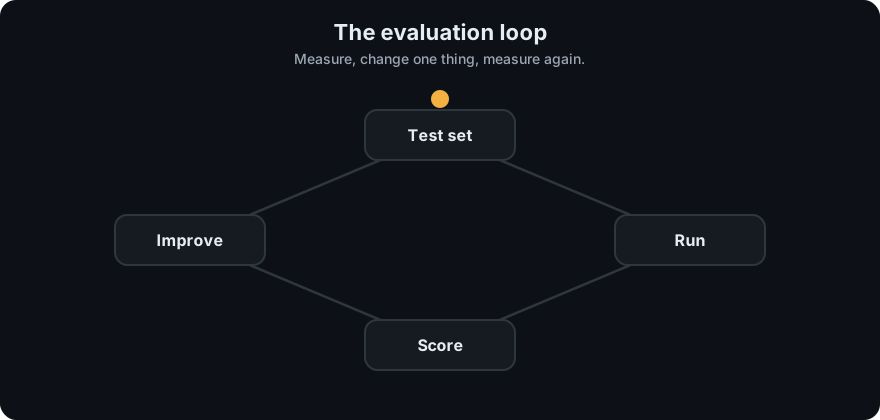
It plays on a loop. Read the caption in the box, one step at a time. Want to go at your own pace? Step through it with Previous and Next.
How it works
- Collect tasks. 20-100 realistic tasks to start, including edge cases and known past failures. For each, write what success looks like (expected answer, expected final state, or a rubric).
- Make runs repeatable. Use mocked or sandboxed tools with fixed data, low temperature, and a fixed agent version.
- Run every task (several times if output varies) and record the full trace: each tool call, arguments, results, tokens, time.
- Grade:
- Code checks (preferred where possible): exact answer, final database state, required tool called, forbidden tool never called.
- LLM-as-judge with a rubric for open-ended answers. Spot-check the judge against human labels.
- Human review for a sample.
- Aggregate metrics and compare against the previous version before shipping.
- Monitor in production with the same metrics on real traffic, and add new failures to the test set.
flowchart LR
    T[test tasks + expected outcomes] --> R[run agent with mocked tools]
    R --> TR[traces]
    TR --> G1[code checks]
    TR --> G2[LLM judge + rubric]
    TR --> G3[human spot-check]
    G1 & G2 & G3 --> M[metrics: success, steps, cost, violations]
    M --> D{better than last version?}
Worked example
The evaluator in the code below runs two test cases on the offline agent. Real output of evaluate(CASES):
(1.0, [{'outcome_ok': True, 'trajectory_ok': True, 'steps': 3, 'errors': 0},
{'outcome_ok': True, 'trajectory_ok': True, 'steps': 3, 'errors': 0}])- Case 1 asks for double the population of France. The answer must contain
136, and the trace must include bothlookupandmultiply. Both checks pass (outcome and trajectory). - Case 2 uses a model that never stops calling
lookup. The expected result is the answerStopped(the step cap works), withlookupcalled. This also passes. - Both cases pass, so the success rate is
2 / 2 = 1.0. Each run took 3 trace entries and had no tool errors.
Notice that case 2 "passes" by stopping safely. Good evals test failure behaviour too.
Useful metrics:
| Metric | What it tells you |
|---|---|
| Task success rate | does it work? |
| Tool-call accuracy | right tool, valid arguments |
| Steps / tokens / cost per task | efficiency |
| Latency | user experience |
| Guardrail violations | safety (target: 0) |
| pass^k (success on all k repeated runs) | consistency |
Code example
A tiny evaluator for the offline ReAct agent in agent_react.py. It grades the outcome, the trajectory, and efficiency.
from agent_react import ScriptedLLM, run_react, DEMO_SCRIPT

CASES = [
    {"question": "What is double the population of France?", "script": DEMO_SCRIPT,
     "expect_in_answer": "136", "must_call": {"lookup", "multiply"}, "max_steps": 4},
    {"question": "Loop forever", "script": ['Action: lookup\nAction Input: {"topic": "japan"}'],
     "expect_in_answer": "Stopped", "must_call": {"lookup"}, "max_steps": 3},
]

def evaluate(cases):
    rows = []
    for c in cases:
        answer, trace = run_react(ScriptedLLM(c["script"]), c["question"], max_steps=c["max_steps"])
        called = {t["tool"] for t in trace if t["type"] == "action"}
        rows.append({
            "outcome_ok": c["expect_in_answer"] in answer,
            "trajectory_ok": c["must_call"] <= called,
            "steps": len(trace),
            "errors": sum(1 for t in trace if "Error" in t.get("observation", "")),
        })
    success = sum(r["outcome_ok"] and r["trajectory_ok"] for r in rows) / len(rows)
    return success, rows

print(evaluate(CASES))
With a real model you'd replace ScriptedLLM with an API-backed one and keep tools mocked. More on evaluation methods: Phase 2 · Advanced RAG.
When to use it / when not to
- Always have some eval before changing prompts, models, or tools. Otherwise you can't tell improvements from regressions.
- Start small (20 tasks) and grow from real failures.
- Don't rely only on LLM judges; they have biases and should be checked against human labels.
Common mistakes
- Judging only the final answer and missing dangerous or wasteful steps.
- Running each task once when the agent is non-deterministic.
- Evaluating against live tools, so results change because the world changed, not the agent.
- A test set that never grows, so new failure types go unmeasured.
- Ignoring cost and latency until production.
Recap
If you remember only three things:
- Evaluate an agent on a fixed test set: the outcome, the steps it took, the cost, and safety.
- Make runs repeatable with mocked tools, and save the full trace of each run.
- Prefer code checks, use LLM judges carefully, and add every new failure to the test set.
Interview questions
1. What is the difference between outcome and trajectory evaluation? <details><summary>Answer</summary> Outcome evaluation checks whether the final result is correct. Trajectory evaluation checks the steps: which tools were called, with what arguments, in what order, and whether any forbidden or wasteful actions happened. </details>
2. How do you make agent evals repeatable? <details><summary>Answer</summary> Mock or sandbox tools with fixed data, pin the model and prompt versions, use low temperature, run each task multiple times, and store full traces for comparison. </details>
3. What are the risks of LLM-as-judge? <details><summary>Answer</summary> Judges can be biased (toward longer answers, their own style, or position), inconsistent, and wrong on specialized facts. Use clear rubrics, structured scores, and validate against human-labelled samples. </details>
Go deeper
- τ-bench: A Benchmark for Tool-Agent-User Interaction (Yao et al., 2024)
- Judging LLM-as-a-Judge with MT-Bench and Chatbot Arena (Zheng et al., 2023)
- SWE-bench: Can Language Models Resolve Real-World GitHub Issues? (Jimenez et al., 2023)
Prev: Human in the Loop · Next: Agent Guardrails · Back to phase: Phase 4