ReAct Pattern
On this page
Level: Intermediate · Reading time: 9 min · Phase: 4 · Agentic AI
In one line: ReAct (Reason + Act) is an agent pattern where the model alternates between writing a short thought, taking an action with a tool, and reading the observation, until it can answer.
Before you start: What is an AI Agent? and Tool Calling. You should know the agent loop and that tools are functions your code runs.
Explain it like I'm new
Think of how a detective solves a case. "I think the butler was in the kitchen" (thought). "Let me check the kitchen camera" (action). "The camera shows nobody at 9 pm" (observation). "So the butler lied; let me check his phone records" (next thought). Each clue changes the next step.
The ReAct paper (Yao et al., 2022) showed that mixing reasoning traces (thoughts in plain text) with actions (tool calls) works better than either alone on several tasks:
- Reasoning only (chain-of-thought) can drift into made-up facts because it never checks anything.
- Acting only can wander, because the model doesn't plan what to look for next.
Interleaving the two lets the model plan, gather facts, and adjust.
Words to know:
- Thought: a short line of text where the model says what it is thinking.
- Action: the tool the model chooses to use, plus its input.
- Observation: the result of the tool, written into the transcript by your code.
- Transcript: the running text of the question, thoughts, actions, and observations so far.
- Chain-of-thought: prompting the model to write out its reasoning step by step before answering.
- Parse: read the model's text and pull out the tool name and input.
Watch it
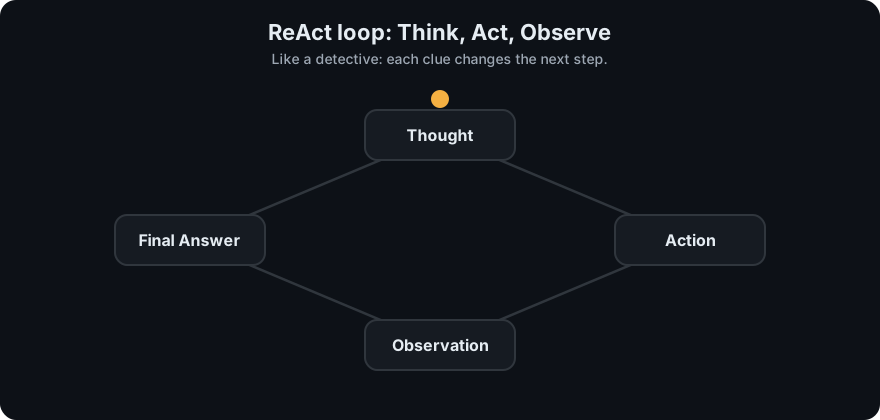
It plays on a loop. Read the caption in the box, one step at a time. Want to go at your own pace? Step through it with Previous and Next.
How it works
The model writes text in a fixed format, and your code parses it:
Question: What is double the population of France?
Thought: I need France's population.
Action: lookup
Action Input: {"topic": "france"}
Observation: France has a population of about 68 million. Capital: Paris.
Thought: About 68 million. Double that.
Action: multiply
Action Input: {"a": 68, "b": 2}
Observation: 136
Thought: I have the result.
Final Answer: Double France's population is about 136 million.- Build a prompt: instructions, tool list, the question, and the transcript so far.
- Call the model. It writes a Thought and either an Action + Action Input, or a Final Answer.
- If it's an action: parse it, run the tool, append
Observation: <result>to the transcript. - If parsing fails: append an error as the observation so the model can fix its format.
- Repeat until Final Answer or max steps.
flowchart TD
    Q[Question] --> T[Thought]
    T --> A{Action or Final Answer?}
    A -- Action --> X[run tool] --> O[Observation] --> T
    A -- Final Answer --> F[return answer]
Worked example
Question: "What is double the population of France?" The demo python 04-agentic-ai/code/agent_react.py ran two tools. Its real printed steps were:
{'type': 'action', 'tool': 'lookup', 'args': {'topic': 'france'}, 'observation': 'France has a population of about 68 million. Capital: Paris.'}
{'type': 'action', 'tool': 'multiply', 'args': {'a': 68, 'b': 2}, 'observation': '136'}
{'type': 'final', 'answer': "Double France's population is about 136 million."}
Trace it:
- Thought: I don't know the population. Action:
lookupwith{"topic": "france"}. - Your code runs
lookup. Observation: about 68 million. - Thought: now I just need to double it. Action:
multiplywith{"a": 68, "b": 2}. - Your code runs
multiply. Observation:136. - Thought: I have what I need. Final Answer: about 136 million.
The second action depends on the first observation. A fixed script could not have known the number 68 in advance. (The model here is scripted, so the thoughts are the ones in the transcript at the top of this section.)
ReAct today. The original paper used plain text and parsing. Modern APIs have native tool calling, so the "Action" is a structured tool call instead of text. The idea is the same: think, act, observe, repeat. Most agent frameworks implement this loop (for example LangGraph's prebuilt ReAct agent).
Code example
From agent_react.py, runnable offline with a scripted model:
import json, re
from agent_react import dispatch   # validates and runs a tool, returns a string

_ACTION = re.compile(r"Action:\s*(\S+)\s*\nAction Input:\s*(\{.*\})", re.S)
_FINAL = re.compile(r"Final Answer:\s*(.*)", re.S)

def parse(text):
    if m := _FINAL.search(text):
        return ("final", m.group(1).strip())
    m = _ACTION.search(text)
    if not m:
        return ("error", "Use 'Action' + 'Action Input' or 'Final Answer'.")
    try:
        return ("action", m.group(1), json.loads(m.group(2)))
    except json.JSONDecodeError as e:
        return ("error", f"Action Input is not valid JSON: {e.msg}")

def run_react(llm, question, max_steps=5):
    transcript = f"Question: {question}\n"
    for _ in range(max_steps):
        text = llm(transcript)
        transcript += text.strip() + "\n"
        kind, *rest = parse(text)
        if kind == "final":
            return rest[0]
        obs = f"Error: {rest[0]}" if kind == "error" else dispatch(rest[0], rest[1])
        transcript += f"Observation: {obs}\n"
    return "Stopped: reached max steps without a final answer."
Run python 04-agentic-ai/code/agent_react.py to see the full trace. The tests in test_agent_react.py check that observations are fed back, bad formats are recovered from, and the step cap works.
In real projects (LangGraph prebuilt agent; check the LangGraph docs for the current signature):
from langgraph.prebuilt import create_react_agent

def multiply(a: float, b: float) -> float:
    """Multiply two numbers."""
    return a * b

agent = create_react_agent("anthropic:claude-sonnet-4-5", tools=[multiply])
result = agent.invoke({"messages": [{"role": "user", "content": "What is 6 times 7?"}]})
When to use it / when not to
- Use for multi-step questions where each step depends on the last (research, lookups, troubleshooting).
- Don't use for single-step tasks; a plain tool call or a workflow is cheaper.
- Every step is another model call: cost and latency grow with steps.
| Pattern | Thinks | Acts | Risk |
|---|---|---|---|
| Chain-of-thought | yes | no | made-up facts |
| Act-only | no | yes | aimless actions |
| ReAct | yes | yes | more calls, needs step cap |
Common mistakes
- No step cap, so it loops on the same action.
- Brittle parsing that crashes on small format changes. Return parse errors as observations instead.
- Letting the model invent the Observation line itself. Stop generation before "Observation:" (or use native tool calling), and only your code writes observations.
- Huge observations that bury earlier thoughts. Truncate or summarize tool outputs.
- Thinking the Thought line is a tool. It is only text for planning, and nothing runs until there is an Action.
Recap
If you remember only three things:
- ReAct repeats Thought, Action, Observation until the model writes a Final Answer.
- Real observations from tools keep the reasoning honest, and the reasoning picks the next action.
- Cap the steps, return parse errors as observations, and let only your code write observations.
Interview questions
1. What problem does ReAct solve compared with chain-of-thought alone? <details><summary>Answer</summary> Chain-of-thought reasons only from what the model already knows, so errors and made-up facts compound. ReAct grounds reasoning with real observations from tools, and uses reasoning to decide which action to take next. </details>
2. What are the three repeating parts of a ReAct step? <details><summary>Answer</summary> Thought (reasoning text), Action (tool name and input), Observation (the tool result inserted by your code). It ends with a Final Answer. </details>
3. How do you stop a ReAct agent from looping forever? <details><summary>Answer</summary> A hard max_steps limit, detecting repeated identical actions, a token or cost budget, and a clear stop condition in the prompt. Return a "stopped" result when the limit is hit. </details>
Go deeper
- ReAct: Synergizing Reasoning and Acting in Language Models (Yao et al., 2022)
- Chain-of-Thought Prompting (Wei et al., 2022)
Prev: Function Calling · Next: Planning Agents · Back to phase: Phase 4