Hallucination
On this page
Level: Intermediate · Reading time: 8 min · Phase: 3 · LLM Concepts
In one line: A hallucination is when a model produces fluent, confident text that is false or not supported by its sources.
Before you start: Temperature and Context Window.
Words to know:
- Hallucination: confident text from a model that is false or not backed by its sources.
- Grounding: giving the model real source text or tools so it answers from facts, not guesses.
- RAG (retrieval-augmented generation): looking up relevant documents first and putting them in the prompt.
- Factuality: whether a claim is true about the world.
- Faithfulness: whether a claim is supported by the text the model was given.
Explain it like I'm new
Think of a student in an exam who doesn't know the answer but writes something that sounds right, in perfect grammar, because a blank answer gets zero marks. LLMs behave in a similar way. They are trained to produce the most plausible next token, not to check facts. When the true answer is missing from what they learned or from the prompt, a plausible-sounding guess comes out with the same confident tone as a correct answer.
Common forms:
- Made-up facts: wrong dates, numbers, or people.
- Fake citations: papers, URLs, or court cases that don't exist.
- Unfaithful summaries: the summary says something the source never said. This is often called an unfaithful or ungrounded output.
- Invented tools or APIs: code that calls functions that don't exist.
Researchers often split these into factuality errors (wrong about the world) and faithfulness errors (not supported by the given context).
Watch it
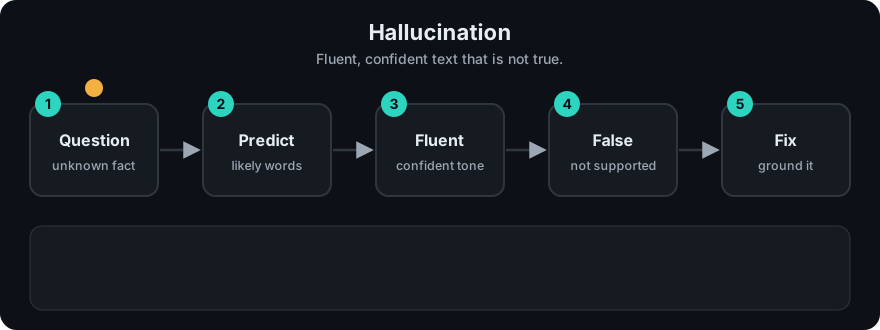
It plays on a loop. Read the caption in the box, one step at a time. Want to go at your own pace? Step through it with Previous and Next.
How it works
Why it happens, step by step:
- Training goal: predict likely text. "Likely" and "true" usually overlap, but not always.
- Missing or rare knowledge: facts seen rarely in training are stored weakly. The model fills the gap with a pattern that fits.
- No built-in lookup: a plain LLM has no database to check against unless you give it one (RAG, tools).
- Decoding: sampling can pick a less likely, wrong token; once written, the model continues consistently with it.
- Pressure to answer: prompts and training that reward helpful-sounding answers can discourage "I don't know".
flowchart LR
    Q[question] --> K{knowledge in<br/>weights or context?}
    K -- yes --> A[likely correct answer]
    K -- no / weak --> G[plausible-sounding guess] --> H[hallucination]
    R[RAG / tools: give sources] --> K
    V[verify: citations, checks, evals] --> H
How to reduce it (none removes it fully):
- Ground the model: give it the source text (RAG) or tools (search, database, calculator).
- Instruct it to answer only from the provided context and to say "I don't know" otherwise.
- Ask for citations that point to specific passages, then check them in code.
- Constrain output with schemas (JSON with required fields) so it can't ramble.
- Verify: a second pass or a separate check compares claims to sources.
- Evaluate on a test set of questions with known answers, and track the rate over time.
Worked example
Use the code example below. The source says: "The Eiffel Tower is in Paris. It was completed in 1889." The answer says: "The Eiffel Tower is in Paris. It was designed by Leonardo da Vinci in 1450."
- Split the answer into two sentences.
- Sentence 1 has 6 words: the, eiffel, tower, is, in, paris. All 6 appear in the source, so overlap is 6/6 = 1.0. It passes the 0.5 limit.
- Sentence 2 has 9 words: it, was, designed, by, leonardo, da, vinci, in, 1450. Only "it", "was" and "in" appear in the source, so overlap is 3/9 ≈ 0.33. That is below 0.5, so it is flagged.
- The flagged sentence is the made-up one. This matches the printed output in the code example.
This is a crude word-overlap check, so it can miss a false sentence that reuses the source's words. That is why real systems use stronger checks.
Code example
A tiny groundedness check: flag answer sentences that share few words with the source. Real systems use stronger methods (NLI models or an LLM judge), but the idea is the same.
import re

def words(text):
    return set(re.findall(r"[a-z0-9]+", text.lower()))

def unsupported_sentences(answer, source, min_overlap=0.5):
    src = words(source)
    flagged = []
    for sent in re.split(r"(?<=[.!?])\s+", answer.strip()):
        w = words(sent)
        if w and len(w & src) / len(w) < min_overlap:
            flagged.append(sent)
    return flagged

source = "The Eiffel Tower is in Paris. It was completed in 1889."
answer = "The Eiffel Tower is in Paris. It was designed by Leonardo da Vinci in 1450."
print(unsupported_sentences(answer, source))
# ['It was designed by Leonardo da Vinci in 1450.']
A prompt pattern that helps:
Answer using ONLY the documents below. Quote the sentence you used in [brackets].
If the documents do not contain the answer, reply exactly: "I don't know based on the provided documents."
When to use it / when not to
Every LLM product needs a plan for hallucination. How strict depends on risk.
| Risk level | Example | Controls |
|---|---|---|
| Low | brainstorming names | none needed, creativity is the goal |
| Medium | internal knowledge bot | RAG + citations + "I don't know" |
| High | medical, legal, finance | RAG + verification + human review + evals |
Common mistakes
- Believing low temperature fixes it. It only makes the same answer more likely.
- Trusting citations without checking that they exist and say what is claimed.
- Adding RAG but retrieving the wrong documents. Bad retrieval leads to confident wrong answers.
- Measuring hallucination by "it looked fine in a demo" instead of a labelled test set.
Recap
If you remember only three things:
- A hallucination is fluent, confident text that is false or unsupported, because the model predicts likely text and does not check facts.
- Grounding (RAG, tools), "answer only from the context", citations and evals reduce it, but none removes it.
- Low temperature does not fix it: a consistently wrong answer is still wrong.
Interview questions
1. Why do LLMs hallucinate? <details><summary>Answer</summary> They are trained to generate plausible text, not to verify facts. When knowledge is missing or weak, the most plausible continuation can be false, and the model has no built-in way to check unless given sources or tools. </details>
2. What is the difference between a factuality and a faithfulness error? <details><summary>Answer</summary> Factuality: the claim is wrong about the world. Faithfulness: the claim isn't supported by the provided context (for example a summary adding facts not in the document), even if it happens to be true. </details>
3. Name three practical ways to reduce hallucinations in a RAG app. <details><summary>Answer</summary> Improve retrieval quality, instruct the model to answer only from context and abstain otherwise, require citations and verify them, and run an evaluation set that measures groundedness. </details>
Go deeper
- Survey of Hallucination in Natural Language Generation (Ji et al., 2022)
- Anthropic docs: reduce hallucinations
Prev: Beam Search · Next: Prompt Engineering · Back to phase: Phase 3