HyDE
On this page
Level: Advanced · Reading time: 8 min · Phase: 2 — Advanced RAG
In one line: HyDE (Hypothetical Document Embeddings) asks an LLM to write a fake answer to the question, then searches with that fake answer instead of the question.
Before you start: Bi Encoder and Query Expansion. You should know that text is embedded as a vector, and that the query can be rewritten before searching.
Explain it like I'm new
Suppose you want a photo of "a cosy reading corner". Searching for that phrase works so-so. Now imagine you first sketch the picture — armchair, lamp, bookshelf, blanket — and then search for photos that look like your sketch. Your sketch is wrong in details, but it looks much more like the real photos than the four-word phrase did.
Questions and answers look different. A question is short and full of "how", "why", "what". Documents are long, declarative statements. In embedding space, a question can sit far from the passage that answers it. HyDE closes that gap: the LLM writes a hypothetical document, a plausible answer that may contain made-up details. You embed that and search for real documents near it. Real documents that answer the question tend to look like a plausible answer.
Words to know:
- Hypothetical document: a made-up passage that looks like a real answer; it may contain wrong details.
- Embedding: the list of numbers that represents a text's meaning.
- Embedding space: the "map" where texts with similar meaning sit close together.
- Zero-shot: working without any training examples for your specific data.
- LLM: a large language model, the kind of AI that writes text.
The fake answer is never shown to the user and never used as evidence. It is only a better search key. The final answer is still generated from the real retrieved chunks.
Watch it
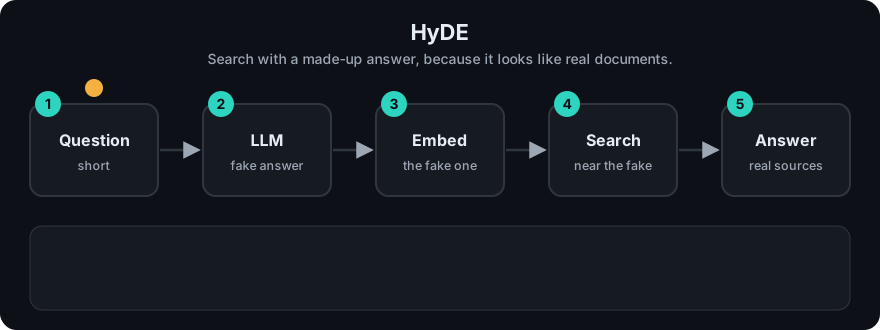
It plays on a loop. Read the caption in the box, one step at a time. Want to go at your own pace? Step through it with Previous and Next.
How it works
- Prompt the LLM: "Write a short passage that answers this question."
- Embed the generated passage (optionally average several passages, and the question too).
- Run vector search with that embedding.
- Pass the real retrieved chunks and the original question to the LLM for the answer.
flowchart LR
    Q[Question] --> L[LLM: write a<br/>hypothetical answer]
    L --> H[Fake passage]
    H --> E[Embed] --> V[(Vector index)]
    V --> R[Real chunks]
    R --> G[LLM answers<br/>original question]
    Q --> G
Example. Question: "Why does my pod crash over and over?" The fake passage: "A pod that keeps crashing goes into CrashLoopBackOff; Kubernetes restarts the container with back-off delays." Searching with this text matches the real CrashLoopBackOff document first, because it shares the document's vocabulary and style.
Worked example
Corpus: d1 (liveness probe restarts a container), d2 (CrashLoopBackOff), d3 (readiness probes). Question: "Why does my pod crash over and over?"
- Generate. The demo's fake LLM returns: "A pod that keeps crashing goes into CrashLoopBackOff; Kubernetes restarts the container with back-off delays."
- Search with the passage, not the question. It shares words with the real documents, such as CrashLoopBackOff, restarts and container.
- Result:
['d2', 'd1', 'd3'].d2is first, andd1is also found. A plain keyword search on the question returned only['d2', 'd3']. - Answer. The LLM gets the original question plus the real chunks
d2andd1. The fake passage is thrown away.
The original paper (Gao et al., 2022) used this for zero-shot dense retrieval: no relevance labels were needed to train the retriever.
Code example
From adv_query_transform.py:
def hyde_prompt(question):
    return (
        "Write a short passage that answers the question. It may contain made-up details.\n"
        f"Question: {question}\nPassage:"
    )

def hyde_retrieve(question, llm, corpus=CORPUS, k=3):
    hypothetical = llm.complete(hyde_prompt(question)).strip()
    return hypothetical, keyword_search(hypothetical, corpus, k)

passage, top = hyde_retrieve("Why does my pod crash over and over?", FakeLLM())
print(top)  # ['d2', 'd1', 'd3'] -> d2 is the CrashLoopBackOff doc
The demo searches with keywords to stay offline. In a real system you would embed hypothetical with the same embedding model used for your documents.
When to use it / when not to
- Use it when queries are short and documents are long and formal (technical docs, papers, policies).
- Use it when you have no labelled data to fine-tune a retriever.
- Avoid it for questions about things the LLM knows nothing about (private product names, internal codes). The fake passage may drift to the wrong topic.
- Avoid it when latency is tight: it adds one generation call before every search.
| Plain query embedding | HyDE | |
|---|---|---|
| Extra LLM call | No | Yes |
| Matches document style | Weak | Strong |
| Risk | Misses paraphrases | Fake passage can mislead search |
Common mistakes
- Showing or citing the hypothetical passage as if it were a source. It may be fiction.
- Using HyDE on exact-match queries (IDs, error codes) where the original query is better.
- Not combining with the original query. Fusing results from both (for example with RRF) is a safer default.
- Using a long generation. A short paragraph is usually enough and cheaper.
Recap
If you remember only three things:
- HyDE has an LLM write a fake answer, then searches with that fake answer instead of the short question.
- The fake passage is only a search key. Never show it or use it as evidence.
- It helps when questions are short and documents are formal, but costs an extra LLM call and can mislead search on unfamiliar topics.
Interview questions
1. Why does searching with a fake answer work? <details><summary>Answer</summary> Answer-like text is closer in embedding space to real answer passages than a short question is. Even if details are wrong, the vocabulary and structure match relevant documents, so nearest-neighbour search finds them. </details>
2. What's the main risk of HyDE? <details><summary>Answer</summary> If the LLM misunderstands the question or lacks domain knowledge, the hypothetical document points search in the wrong direction. It also adds latency and cost. </details>
3. Is the hallucinated passage a problem for faithfulness? <details><summary>Answer</summary> Not if it is used only as a search key. The final answer must be grounded only in real retrieved chunks; the hypothetical passage should never enter the answer prompt as evidence. </details>
Go deeper
Prev: Multi Query Retrieval · Next: Step Back Prompting · Back to phase: Phase 2