Short-term Memory
On this page
Level: Beginner · Reading time: 6 min · Phase: 4 · Agentic AI
In one line: Short-term memory is the recent conversation (and tool results) that you re-send to the model on every turn, usually trimmed to a window so it fits the context.
Before you start: Memory and the context window. You should know that the model forgets between calls, so you re-send the conversation.
Explain it like I'm new
Think of a sticky note on your desk during a phone call. You jot down the last few things the caller said so you can follow along. When the note fills up, you erase the oldest lines. You don't keep a full transcript on the note, just what you need right now.
In an agent, short-term memory is the list of messages for the current session: user messages, assistant replies, tool calls, and tool results. It is also called working memory or the conversation buffer. On each turn, you send this list to the model again. That's how it "remembers" what you said two messages ago.
The problem: the list keeps growing. Each turn costs more tokens (small chunks of text that models count and charge by). Eventually it doesn't fit in the context window, which is the most text the model can read at once. So you need a policy for trimming.
Words to know:
- Turn: one round of the conversation.
- Buffer: the list of recent messages you keep.
- Sliding window: keep only the newest N messages, and let older ones slide out.
- Summary: a short text that stands in for older messages.
- System prompt: the standing instructions you give the model at the start.
- Deque: a Python list-like container. With
maxlen, it drops the oldest item when full.
Watch it
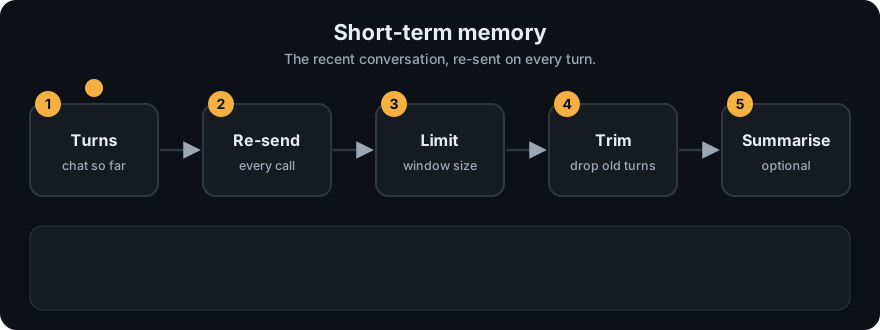
It plays on a loop. Read the caption in the box, one step at a time. Want to go at your own pace? Step through it with Previous and Next.
How it works
Common policies:
- Sliding window (buffer window): keep only the last N messages (or last N tokens). Simple and predictable.
- Summary + window: keep the last N messages in full, plus a running summary of older ones written by the model.
- Token budget: drop the oldest messages until the total fits a budget.
- Always keep: the system prompt, the original goal, and any pinned facts, no matter what.
window size = 3
turn 1: [m0]
turn 2: [m0, m1]
turn 3: [m0, m1, m2]
turn 4: [m1, m2, m3]        <- m0 falls off
turn 5: [m2, m3, m4]        <- m1 falls off
Tool-call pairs. If you trim in the middle of a tool call and its result, some APIs reject the history (a result without its call). Trim at turn boundaries.
Code example
From agent_memory.py, using collections.deque with maxlen, which drops the oldest item automatically:
from collections import deque

class ShortTermMemory:
    def __init__(self, max_messages=4):
        self.buffer = deque(maxlen=max_messages)

    def add(self, role, content):
        self.buffer.append({"role": role, "content": content})

    def messages(self):
        return list(self.buffer)

stm = ShortTermMemory(max_messages=3)
for i in range(5):
    stm.add("user", f"message {i}")
print([m["content"] for m in stm.messages()])   # ['message 2', 'message 3', 'message 4']
Worked example
Five messages go into a window of size 3. Real output of the code above:
['message 2', 'message 3', 'message 4']Trace it: messages 0 and 1 went in first. When message 3 arrived, message 0 slid out. When message 4 arrived, message 1 slid out. Only the newest three remain, and that is exactly what you would re-send to the model.
Now the summary + window version. Take 8 messages m0 to m7 and call compact(messages, keep_last=3). Real output:
['Summary of earlier conversation: 5 earlier messages about deployment', 'm5', 'm6', 'm7']The last 3 messages stay word for word. The 5 older ones (m0 to m4) become one summary line. Details in those 5 may be lost, but the gist stays and the prompt is shorter.
A summary + window version (the summarizer would be an LLM call in practice):
def compact(messages, keep_last=6, summarize=lambda msgs: f"{len(msgs)} earlier messages about deployment"):
    if len(messages) <= keep_last:
        return messages
    old, recent = messages[:-keep_last], messages[-keep_last:]
    return [{"role": "user", "content": f"Summary of earlier conversation: {summarize(old)}"}] + recent
When to use it / when not to
| Policy | Pros | Cons |
|---|---|---|
| Full history | nothing lost | cost grows, overflows eventually |
| Sliding window | simple, bounded cost | forgets older details |
| Summary + window | keeps gist of long chats | summary can lose or distort details, extra call |
| Token budget | precise fit | needs token counting |
- For short sessions, keeping the full history is fine.
- For long sessions, use summary + window, and move durable facts into semantic memory.
Common mistakes
- Dropping the system prompt or the original goal when trimming.
- Splitting a tool call from its result.
- Counting messages instead of tokens when one message is huge (a pasted document).
- Never summarizing, so the agent forgets a decision made 30 turns ago.
- Thinking trimmed messages are saved somewhere. A message that falls out of the window is gone unless you stored it elsewhere.
Recap
If you remember only three things:
- Short-term memory is the recent conversation that you re-send on every turn.
- Trim it with a sliding window, a summary plus recent messages, or a token budget.
- Always keep the system prompt and the goal, and trim a tool call together with its result.
Interview questions
1. What is a buffer window memory? <details><summary>Answer</summary> A short-term memory that keeps only the last N messages (or tokens) of the conversation, dropping the oldest, so the prompt stays within budget. </details>
2. How do you keep a long chat coherent without exceeding the context window? <details><summary>Answer</summary> Keep the system prompt and recent turns verbatim, replace older turns with a running summary, and store durable facts in long-term or semantic memory to retrieve when relevant. </details>
3. Why must tool calls and results be trimmed together? <details><summary>Answer</summary> APIs expect each tool result to follow its matching tool call. Removing one but not the other produces an invalid message history or confuses the model. </details>
Go deeper
Prev: Memory · Next: Long-term Memory · Back to phase: Phase 4