Top-p
On this page
Level: Intermediate · Reading time: 7 min · Phase: 3 · LLM Concepts
In one line: Top-p (nucleus) sampling keeps the smallest group of most-likely tokens whose probabilities add up to at least p, then samples only from that group.
Before you start: Temperature and Top-k.
Words to know:
- Cumulative probability: a running total of probabilities as you go down the sorted list.
- Nucleus: the group of tokens kept by top-p.
- Renormalize: rescale the kept probabilities so they add up to 1 again.
- Sampling: picking a token at random, weighted by probability.
- Floating-point tolerance: allowing for tiny rounding errors in decimal arithmetic.
Explain it like I'm new
Imagine you're choosing a restaurant from reviews. Instead of saying "only look at the top 3" (that's top-k), you say "look at the most popular places until you've covered 90% of all visits". In a town with one famous place that gets 95% of visits, you only consider that one. In a city with many equally popular places, you consider many.
That is top-p. The group of kept tokens is called the nucleus. Its size adapts: small when the model is confident, large when it is unsure. The idea and name come from the paper The Curious Case of Neural Text Degeneration. It showed that greedy and beam decoding give repetitive text. It also showed that pure sampling gives text that is too random. It proposed nucleus sampling as a middle path.
Watch it
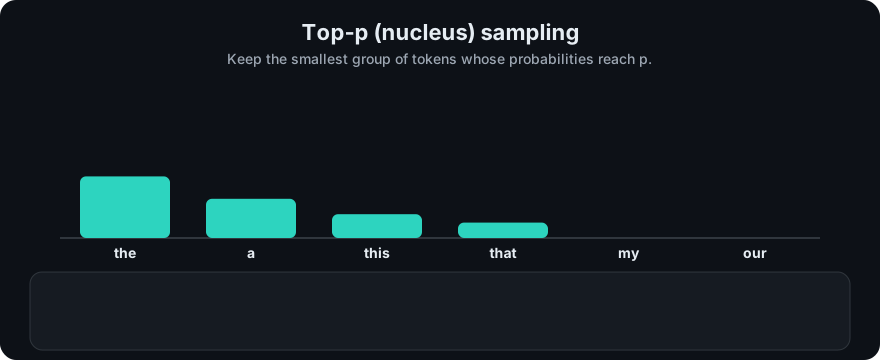
It plays on a loop. Read the caption in the box, one step at a time. Want to go at your own pace? Step through it with Previous and Next.
How it works
- Compute probabilities (after temperature).
- Sort tokens from most to least likely.
- Walk down the list, adding probabilities, until the running total reaches
p. - Keep those tokens; drop the rest.
- Renormalize and sample.
Worked example (toy table in llm_decoding.py), after <start>: the 0.5, a 0.4, my 0.1.
p = 0.5  -> the (0.5)                 -> nucleus {the}
p = 0.9  -> the (0.5) + a (0.4) = 0.9 -> nucleus {the, a}
p = 1.0  -> all three                 -> nucleus {the, a, my}
Adaptive size, side by side with p = 0.9:
confident step:  sat 0.95, ran 0.03, ...      -> nucleus = {sat}            (1 token)
unsure step:     8 tokens at ~0.12 each       -> nucleus = 8 tokens
top-k with k=3 would keep 3 in both cases.
Worked example (step by step)
Probabilities, already sorted: the 0.5, a 0.3, my 0.15, our 0.05. Let p = 0.9.
- Add
the: running total 0.5. That is below 0.9, so continue. - Add
a: total 0.8. Still below 0.9, so continue. - Add
my: total 0.95. That reaches 0.9, so stop. The nucleus is {the, a, my}.ouris dropped. - Renormalize by dividing by 0.95: the 0.526, a 0.316, my 0.158.
- Sample from those three.
With the sampling_demo.py logits at T = 1.0 (Paris 0.76, London 0.13, Rome 0.09, ...), p = 0.9 keeps Paris, London, Rome and renormalizes them to about 0.78, 0.13, 0.10.
flowchart LR
    A[sorted probs] --> B{running sum >= p?}
    B -- no --> C[add next token] --> B
    B -- yes --> D[renormalize kept tokens] --> E[sample]
Code example
From llm_decoding.py:
def top_p_filter(probs, p):
    kept, mass = [], 0.0
    for t, pr in sorted(probs.items(), key=lambda kv: kv[1], reverse=True):
        kept.append((t, pr))
        mass += pr
        if mass >= p - 1e-12:      # small tolerance for floating-point sums
            break
    total = sum(pr for _, pr in kept)
    return {t: pr / total for t, pr in kept}

print(top_p_filter({"the": 0.5, "a": 0.4, "my": 0.1}, 0.9))  # {'the': 0.555..., 'a': 0.444...}
In real projects top_p is a common API parameter:
from openai import OpenAI
client = OpenAI()
resp = client.chat.completions.create(
    model="gpt-4o-mini", top_p=0.9,
    messages=[{"role": "user", "content": "Suggest five names for a bakery."}],
)
OpenAI's docs recommend changing temperature or top_p, not both.
When to use it / when not to
- Use for open-ended generation where you want variety without junk.
- Common values are around 0.9-0.95. Lower p is safer and less varied.
- Skip for exact outputs (JSON, code, extraction): use low temperature instead.
| Top-k | Top-p | |
|---|---|---|
| Cut-off by | count of tokens | cumulative probability |
| Adapts to confidence | no | yes |
| p or k to disable | k = vocab size | p = 1.0 |
Common mistakes
- Setting
pvery low (like 0.1) and wondering why output is nearly greedy. - Tuning
top_pand temperature together and not knowing which change helped. - Forgetting the floating-point tolerance: sums like 0.5 + 0.4 may come out as 0.8999999.
- Believing top-p prevents factual errors. It only limits unlikely tokens.
Recap
If you remember only three things:
- Top-p keeps the smallest group of top tokens whose probabilities add up to at least p, then renormalizes and samples.
- The group size adapts: one token when the model is confident, many when it is unsure.
- It limits unlikely tokens but does not make answers true; change top-p or temperature, not both at once.
Interview questions
1. How does top-p differ from top-k? <details><summary>Answer</summary> Top-k keeps a fixed number of tokens. Top-p keeps the smallest set whose total probability reaches p, so the number of tokens changes with the model's confidence. </details>
2. With probabilities [0.6, 0.25, 0.1, 0.05] and p = 0.8, which tokens are kept? <details><summary>Answer</summary> The first two: 0.6 + 0.25 = 0.85 ≥ 0.8. Renormalized: about 0.71 and 0.29. </details>
3. Why did the nucleus sampling paper argue against beam search for open-ended text? <details><summary>Answer</summary> Maximizing likelihood tends to produce bland, repetitive text, and human text is not always the most probable sequence. Sampling from the nucleus produced text closer to human statistics while avoiding the unreliable tail. </details>
Go deeper
- The Curious Case of Neural Text Degeneration (Holtzman et al., 2019)
- OpenAI API reference: chat completions
Prev: Top-k · Next: Beam Search · Back to phase: Phase 3