Encoder Decoder Models
On this page
Level: Intermediate · Reading time: 8 min · Phase: 3 · LLM Concepts
In one line: An encoder-decoder model first reads the whole input with an encoder, then writes the output with a decoder that looks back at the encoded input through cross-attention.
Before you start: Self Attention and Decoder Only Models.
Words to know:
- Encoder: the half of the transformer that reads the whole input and turns it into rich vectors.
- Decoder: the half that writes the output one token at a time.
- Cross-attention: attention where queries come from the decoder and keys and values come from the encoder.
- Bidirectional: each token can look both left and right.
- Sequence-to-sequence (seq2seq): a task that maps an input sequence to a different output sequence, such as translation.
Explain it like I'm new
Think of a human interpreter at a meeting. First they listen to the full sentence in French (the encoder step: understand everything, in both directions). Then they speak the sentence in English word by word (the decoder step), glancing back at their notes of the French sentence as they go. Those glances are cross-attention.
This was the original transformer design from Attention Is All You Need, built for machine translation. Popular examples are T5 (which frames every task as "text in, text out") and BART. Speech recognition models such as Whisper also use this shape: audio in, text out.
The big difference from decoder-only models: the input gets bidirectional attention (every input token sees every other input token), and the input and output are separate sequences.
Watch it
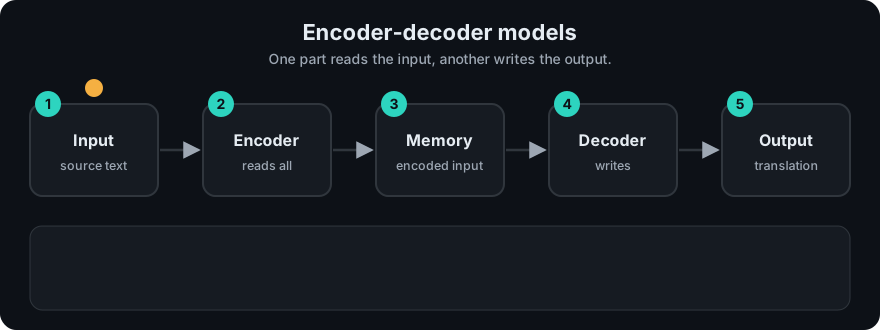
It plays on a loop. Read the caption in the box, one step at a time. Want to go at your own pace? Step through it with Previous and Next.
How it works
- Encoder. The input tokens go through N layers of self-attention without a causal mask, plus feed-forward layers. Output: one context-rich vector per input token.
- Decoder. Generates the output one token at a time. Each decoder layer has three parts:
- Masked self-attention over output tokens produced so far (causal).
- Cross-attention: queries from the decoder, keys and values from the encoder output.
- Feed-forward network.
- The decoder's final vector is turned into next-token probabilities, a token is chosen, and the loop repeats.
- The encoder runs once per input; only the decoder loops.
flowchart LR
    subgraph Encoder
      I[input tokens] --> E[self-attention, no mask<br/>+ feed-forward] --> H[encoded input]
    end
    subgraph Decoder
      O[output so far] --> D1[masked self-attention]
      D1 --> D2[cross-attention]
      H --> D2
      D2 --> D3[feed-forward] --> N[next token]
    end
    N -- append --> O
Worked example
The code example below uses 3 encoded input tokens and 1 output token so far:
- The encoder has already turned the input into
[1,0],[0,1],[0.5,0.5]. - The decoder's current state is
[0.9, 0.1], which acts as the query. - The query is compared to each encoded input token. Token 1 is most similar, so the weights are about
[0.43, 0.24, 0.32](they add up to 1, give or take rounding). - The result is the weighted blend of the inputs:
[0.59, 0.41]. This blend flows into the decoder's feed-forward layer. - At the next output token the decoder asks again, with a new query, against the same encoder output. The encoder does not run again.
Training is like the decoder-only case but the loss is only on the output tokens: given input X, predict output Y token by token. This is also called sequence-to-sequence (seq2seq) learning.
Code example
Cross-attention is the same attention function with Q from one sequence and K, V from another. Uses llm_attention.py.
from llm_attention import scaled_dot_product_attention

encoder_out = [[1.0, 0.0], [0.0, 1.0], [0.5, 0.5]]   # 3 input tokens, already encoded
decoder_state = [[0.9, 0.1]]                          # 1 output token so far

context, weights = scaled_dot_product_attention(
    q=decoder_state, k=encoder_out, v=encoder_out
)
print([round(w, 2) for w in weights[0]])  # which input tokens the decoder "looks at"
print(context)                            # blended information passed to the next layer
In real projects (Hugging Face Transformers, T5):
from transformers import AutoTokenizer, AutoModelForSeq2SeqLM

tok = AutoTokenizer.from_pretrained("t5-small")
model = AutoModelForSeq2SeqLM.from_pretrained("t5-small")
ids = tok("translate English to German: The house is small.", return_tensors="pt")
print(tok.decode(model.generate(**ids, max_new_tokens=20)[0], skip_special_tokens=True))
When to use it / when not to
- Good for tasks with a clear input → output mapping: translation, summarization, speech-to-text, structured rewriting.
- Encoding the input once can be efficient when the input is long and the output is short.
- Less common for general chat. Large decoder-only models handle these tasks well with prompting, and the ecosystem (tools, serving, fine-tuning recipes) centres on them.
| Encoder-decoder | Decoder-only | |
|---|---|---|
| Input attention | bidirectional | causal |
| Input/output | separate sequences | one shared sequence |
| Extra layer | cross-attention | none |
| Typical examples | T5, BART, Whisper | GPT, Llama, Claude |
Common mistakes
- Saying cross-attention and self-attention are different math. The math is the same; only the source of Q vs K/V differs.
- Thinking the encoder re-runs every output step. It runs once; its output is reused.
- Calling BERT an encoder-decoder. BERT is encoder-only.
- Assuming encoder-decoder is "outdated". It is still a strong choice for seq2seq tasks such as speech recognition.
Recap
If you remember only three things:
- The encoder reads the whole input once, in both directions. The decoder then writes the output one token at a time.
- Cross-attention is ordinary attention where the queries come from the decoder and the keys and values come from the encoder.
- Only the decoder's own self-attention is causal. Most general chat LLMs are decoder-only, but encoder-decoder models still suit translation, summarization and speech-to-text.
Interview questions
1. What does cross-attention do? <details><summary>Answer</summary> It lets each decoder position query the encoder's outputs. Queries come from the decoder; keys and values come from the encoder. This is how the output stays tied to the input. </details>
2. Which parts use a causal mask in an encoder-decoder model? <details><summary>Answer</summary> Only the decoder's self-attention. The encoder's self-attention and the cross-attention are not causally masked (padding masks may still apply). </details>
3. Why have decoder-only models become more common for general LLMs? <details><summary>Answer</summary> They are simpler (one stack, one sequence), scale well with next-token prediction on raw text, and can handle input→output tasks by putting the input in the prompt. The tooling around them is also more mature. </details>
Go deeper
- Attention Is All You Need (Vaswani et al., 2017)
- Exploring the Limits of Transfer Learning with a Unified Text-to-Text Transformer (T5, Raffel et al., 2019)
Prev: Decoder Only Models · Next: KV Cache · Back to phase: Phase 3