Decoder Only Models
On this page
Level: Intermediate · Reading time: 8 min · Phase: 3 · LLM Concepts
In one line: A decoder-only model is a transformer that reads text left to right and is trained to predict the next token; this is the design behind GPT, Claude, Llama, and most chat LLMs.
Before you start: Transformer Architecture and Self Attention.
Words to know:
- Decoder: the half of the transformer that writes output one token at a time.
- Autoregressive: each new token is predicted from all the tokens before it, then added to the sequence.
- Causal mask: a rule that stops each position from looking at later positions.
- Pretraining: the first, very large training run, where the model learns to predict the next token on lots of text.
- Loss (cross-entropy): a number measuring how surprised the model was by the right answer. Training tries to make it smaller.
- Base model vs chat model: a base model only continues text. A chat model has extra training to follow instructions.
Explain it like I'm new
Think of the autocomplete on your phone, scaled up massively. You type "See you", it suggests "tomorrow". A decoder-only model does the same thing, one token at a time, and then feeds its own guess back in to guess the next one. Doing this over and over produces whole paragraphs, code, or answers.
"Decoder-only" means the model keeps only the decoder half of the original transformer. It has no separate encoder. Your prompt and the model's answer live in one single sequence. The model is autoregressive: each new token depends on all the tokens before it.
The key rule is the causal mask: when computing position 5, the model may look at positions 0-5 but never 6 and beyond. This matches how text is generated (the future doesn't exist yet) and lets training learn from every position in a document at once.
Watch it
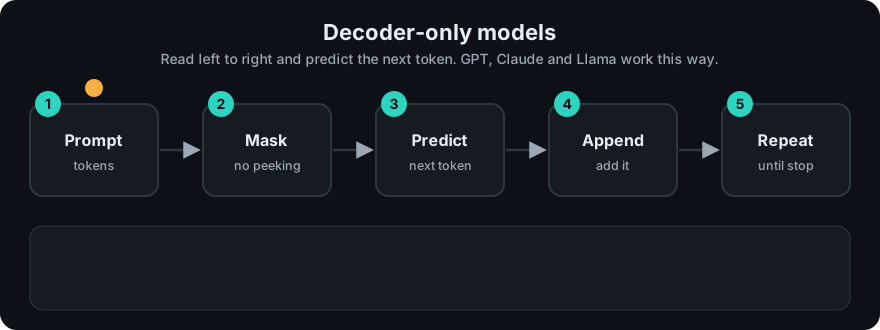
It plays on a loop. Read the caption in the box, one step at a time. Want to go at your own pace? Step through it with Previous and Next.
How it works
Training (pretraining):
- Take a huge amount of text, cut it into token sequences.
- For every position, the target is the next token. "The cat sat" trains: "The" → "cat", "The cat" → "sat".
- The causal mask stops each position from peeking at its answer.
- The loss is cross-entropy: how surprised the model was by the real next token. One forward pass trains all positions in parallel.
Inference (generation):
- Tokenize the prompt.
- Run the model and get probabilities for the next token.
- Pick one with a decoding strategy (Temperature, Top-k, Top-p).
- Append it to the sequence and repeat until a stop token or a length limit.
Causal mask for 4 tokens (1 = may attend, 0 = blocked)
            The  cat  sat  on
   The   [   1    0    0    0 ]
   cat   [   1    1    0    0 ]
   sat   [   1    1    1    0 ]
   on    [   1    1    1    1 ]
flowchart LR
P["prompt tokens"] --> M[decoder-only transformer] --> N[next token]
N -- append --> PWorked example
Training on the text The cat sat:
- One pass over the three tokens, with the causal mask on.
- At position 0 (
The) the target iscat. At position 1 (cat, which seesThe cat) the target issat. Both are checked in the same pass. - Each position sees only itself and earlier tokens, so none can peek at its own answer. The code example below prints these weight rows:
[1.0, 0.0, 0.0],[0.33, 0.67, 0.0],[0.25, 0.25, 0.5]. The zeros mark blocked (future) tokens.
Generating with the toy decoder in llm_decoding.py:
- The toy model starts from a
<start>marker (not part of the output) and picksthe. theis appended, and the model pickscat.- Then
sat, then<end>(a stop token). The real printed output is['the', 'cat', 'sat', '<end>'].
Training reads everything at once. Generation must go one token at a time.
From base model to chat model. A pretrained "base" model only continues text. To follow instructions, it is further trained with instruction tuning (supervised examples) and preference methods such as RLHF (reinforcement learning from human feedback).
Code example
A causal mask and a generation loop, both stdlib. Uses llm_attention.py and llm_decoding.py.
from llm_attention import causal_mask, scaled_dot_product_attention
from llm_decoding import greedy

X = [[1.0, 0.0], [0.0, 1.0], [1.0, 1.0]]
_, w = scaled_dot_product_attention(X, X, X, causal_mask(3))
print([[round(v, 2) for v in row] for row in w])
# first row is [1.0, 0.0, 0.0]: token 0 can only see itself

print(greedy())  # ['the', 'cat', 'sat', '<end>']  autoregressive: one token at a time
In real projects (Hugging Face Transformers):
from transformers import AutoModelForCausalLM, AutoTokenizer

tok = AutoTokenizer.from_pretrained("gpt2")
model = AutoModelForCausalLM.from_pretrained("gpt2")
ids = tok("The capital of France is", return_tensors="pt")
out = model.generate(**ids, max_new_tokens=5, do_sample=False)
print(tok.decode(out[0]))
When to use it / when not to
- Use for open-ended generation: chat, writing, code, agents, summarization, extraction with prompts.
- Decoder-only models are general. With prompting they handle tasks that once needed special models.
- Consider an encoder model (like BERT) for cheap classification or embeddings at large scale.
| Family | Sees | Trained to | Good at |
|---|---|---|---|
| Decoder-only (GPT, Llama, Claude) | left context only | predict next token | generation, chat |
| Encoder-only (BERT) | both sides | fill masked tokens | classification, embeddings |
| Encoder-decoder (T5, BART) | input fully, output left-to-right | map input to output | translation, summarization |
Common mistakes
- Thinking the model plans the whole answer first. It commits one token at a time (though its internal states can carry information about what comes later).
- Forgetting that the prompt and the answer share the same context window.
- Calling a base model and expecting chat behaviour. Use the instruction-tuned version and its chat template.
- Assuming output is deterministic. With sampling, it varies unless you use greedy decoding (and even then, hardware can add tiny differences).
Recap
If you remember only three things:
- A decoder-only model predicts the next token, appends it, and repeats. This is autoregressive generation.
- The causal mask means each token sees only earlier tokens, which lets training learn from every position in one pass.
- Prompt and answer share one sequence and one context window. A base model only continues text, while a chat model is further tuned to follow instructions.
Interview questions
1. What is the causal mask and why is it needed? <details><summary>Answer</summary> It blocks each position from attending to later positions. During training this stops the model from seeing the token it must predict, and it matches left-to-right generation at inference. </details>
2. Why can training be parallel while generation is sequential? <details><summary>Answer</summary> In training the whole target text is known, so all positions are predicted in one pass with the mask. In generation each new token depends on the previous one, which is not known until it is sampled. </details>
3. What is the difference between a base model and a chat model? <details><summary>Answer</summary> A base model is only pretrained to continue text. A chat model is further tuned on instructions and preference data so it follows requests, uses a conversation format, and refuses unsafe requests. </details>
Go deeper
- Language Models are Few-Shot Learners (GPT-3, Brown et al., 2020)
- Training language models to follow instructions with human feedback (Ouyang et al., 2022)
Prev: Positional Encoding · Next: Encoder Decoder Models · Back to phase: Phase 3