Reflection
On this page
Level: Intermediate · Reading time: 8 min · Phase: 4 · Agentic AI
In one line: Reflection is when an agent reviews its own output (or gets feedback from a critic), writes down what went wrong, and tries again using that feedback.
Before you start: ReAct Pattern and Planning Agents. You should know what a tool call is and how a plan with a risky step is approved.
Explain it like I'm new
When you write an important email, you often re-read it before sending: "Too long. I forgot the deadline. Fix that." Then you send the better version. That re-read-and-fix step is reflection.
Words to know:
- Draft: a first attempt at an answer, code, or plan.
- Critic: a check (a prompt, a model, or plain code) that finds problems in the draft.
- Rubric: a short checklist the critic judges the draft against.
- Revision: a new version of the draft that fixes the problems.
- Weights: the numbers inside a model that training changes. Reflection does not change them.
For agents, reflection usually takes one of two forms:
- Self-critique: the same model checks its draft against the task and revises.
- Critic agent: a separate prompt or model plays reviewer and sends feedback to the worker.
The Reflexion paper (Shinn et al., 2023) went further: after a failed attempt, the agent writes a short verbal lesson ("I searched the wrong name; next time search the full title") and stores it in memory. The next attempt reads those lessons. The paper calls this "verbal reinforcement learning". The model improves across tries without changing its weights.
Reflection works best when there is a real signal to check against: a failing test, a validation error, a rubric, or a tool result. Pure "are you sure?" checks without new information help less and can even make correct answers worse.
Watch it
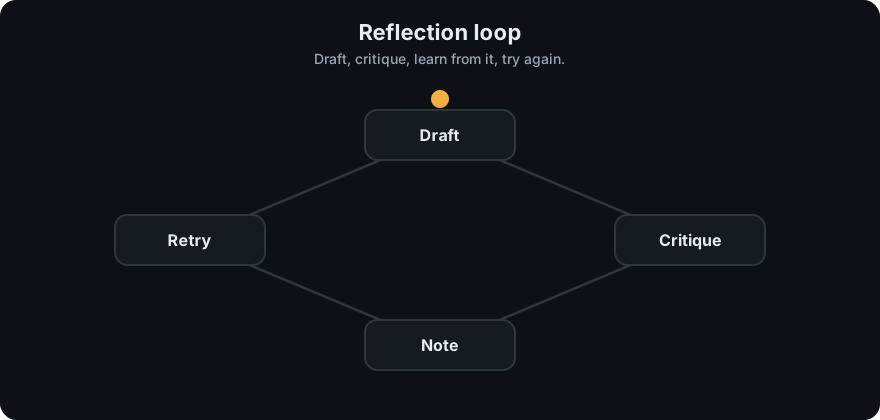
It plays on a loop. Read the caption in the box, one step at a time. Want to go at your own pace? Step through it with Previous and Next.
How it works
- Generate a draft (an answer, code, or plan).
- Evaluate it. Best: an objective check (run the tests, validate the JSON, check citations). Otherwise: a critic prompt with a clear rubric.
- Reflect. Turn the feedback into specific, short notes: what is wrong and what to change.
- Revise using the draft plus the notes.
- Repeat until the check passes or you hit
max_revisions. - Optionally store the lesson in episodic memory for future tasks.
flowchart LR
    T[task] --> W[worker: draft]
    W --> C{critic / tests pass?}
    C -- yes --> D[done]
    C -- no --> R[reflection notes] --> W
    R -. store lesson .-> M[(episodic memory)]
Worked example
Goal: "agents and email it". This is the real log from run_pipeline("agents and email it", ...) in agent_multi.py, with a human who approves:
plan: ['write_text', 'send_email']
write_text -> Draft about agents and email it.
critic: ['needs a concrete example']
add_example -> Draft about agents and email it. Example: a support bot that looks up orders.
human approved send_email
send_email -> EMAIL SENT: Draft about agents and email it. Example: a support bot that looks up orders.
Trace it:
- Generate: the worker writes the draft
Draft about agents and email it. - Evaluate: the critic checks it and finds one problem:
needs a concrete example. - Reflect and revise: the worker adds an example sentence. The draft is now better.
- Approve: the revised draft (not the first one) is shown to the human, who says yes.
- Act: only now does
send_emailrun.
If the human says no instead, the same run ends with the status rejected and the email is never sent. The critic ran before the risky action, which is the safe order.
Code example
From agent_multi.py: a rule-based critic and a revision loop. In a real system the critic could be an LLM with a rubric, or real tests.
def critic(draft):
    problems = []
    if "Example:" not in draft:
        problems.append("needs a concrete example")
    if len(draft) > 300:
        problems.append("too long")
    return problems

def add_example(text):
    return text + " Example: a support bot that looks up orders."

draft = "Draft about agents."
for attempt in range(2):                    # max_revisions
    problems = critic(draft)
    if not problems:
        break
    print("critic:", problems)
    draft = add_example(draft)              # the "worker" revises using the feedback
print(draft)
run_pipeline() in the same file wires this between a planner and a worker, and runs the critic before any risky action (sending an email), so the human approver sees the revised draft. See test_critic_reflection_revises_draft in test_agent_multi.py.
A useful critic prompt shape:
You are reviewing a draft against this rubric:
1. Answers the question asked.  2. Every claim has a citation from <sources>.  3. Under 150 words.
Return JSON: {"pass": true|false, "problems": ["..."], "fix": "one-sentence instruction"}
When to use it / when not to
- Use when you have an objective check (tests, schema, linter, citation check). Reflection plus real feedback is strong.
- Use for high-value outputs where an extra call is worth it (reports, code, plans).
- Avoid endless self-critique loops without new information; quality can plateau or drift.
- Each round costs at least one more model call.
| Feedback source | Reliability | Cost |
|---|---|---|
| Unit tests / validators | high | low |
| LLM critic with rubric | medium | one call per round |
| Same model, "check your work" | lower | one call per round |
| Human reviewer | high | slow |
Common mistakes
- Vague critic prompts ("is this good?") that approve everything.
- No limit on revision rounds.
- Letting the critic and worker share the same blind spot (same prompt, same context). Give the critic the rubric and sources.
- Not saving lessons, so the agent repeats the same mistake on the next task.
- Treating reflection as magic. If nothing new is checked (no test, no rubric), asking "are you sure?" mostly adds cost.
Recap
If you remember only three things:
- Reflection means: draft, check, write down what is wrong, revise, and repeat a limited number of times.
- It works best with a real signal, such as failing tests, a validator, or a rubric.
- Cap the revision rounds, and run the critic before any action you cannot undo.
Interview questions
1. What is Reflexion? <details><summary>Answer</summary> A method where an agent, after a failed attempt, writes a natural-language reflection about what went wrong, stores it in memory, and uses it in the next attempt. It improves performance across trials without updating model weights. </details>
2. When does reflection help most? <details><summary>Answer</summary> When there is an external, informative signal (test failures, error messages, rubric checks, tool results). Without new information, self-correction is much less reliable. </details>
3. How would you add a critic to an agent safely and cheaply? <details><summary>Answer</summary> Use deterministic checks first (schema, tests), then an LLM critic with a specific rubric returning structured JSON, cap the number of revision rounds, and run the critic before any irreversible action. </details>
Go deeper
- Reflexion: Language Agents with Verbal Reinforcement Learning (Shinn et al., 2023)
- Self-Refine: Iterative Refinement with Self-Feedback (Madaan et al., 2023)
Prev: Planning Agents · Next: Memory · Back to phase: Phase 4