Sparse Retrieval
On this page
Level: Intermediate · Reading time: 8 min · Phase: 1 — RAG Foundations
In one line: Sparse retrieval represents text as very long vectors that are mostly zeros — one slot per vocabulary word — and finds documents by matching the words they share with the query.
Before you start: Tokenization and BM25. You should know that text is split into word-like tokens, and that BM25 is a formula that scores documents by their keyword matches.
Explain it like I'm new
Imagine a giant checklist with every word in the dictionary, 50,000 lines long. To describe a document, you tick the words it contains and write how often. A short paragraph ticks maybe 40 lines; the other 49,960 stay empty. That checklist is a sparse vector: huge, but almost all zeros.
Sparse means "mostly zero". Because most entries are zero, the computer only stores the non-zero ones, like {"refresh": 2, "token": 3, "cookie": 1}.
To search quickly, sparse systems use an inverted index: for each word, a list of the documents containing it. It is the index at the back of a book: "token → pages 4, 12, 31". To answer a query, look up each query word, collect the documents, and score them with a formula like TF-IDF or BM25.
The opposite is dense retrieval: short vectors (hundreds of numbers) where almost every entry is non-zero and no single slot means a specific word.
There is also learned sparse retrieval (for example SPLADE): a neural model outputs a sparse vector over the vocabulary, giving weight to related words that were not in the text (it might add "automobile" for a text about "car"). It keeps the inverted-index speed while adding some meaning.
Words to know:
- Vector: a list of numbers that describes a piece of text.
- Vocabulary: the set of all distinct words seen in your documents.
- Query: the search text the user types.
- Inverted index: a map from each word to the documents that contain it.
- Term frequency (TF): how many times a word appears in a document.
- Stop words / stemming: dropping very common words, and cutting words to a base form ("tokens" to "token").
Watch it
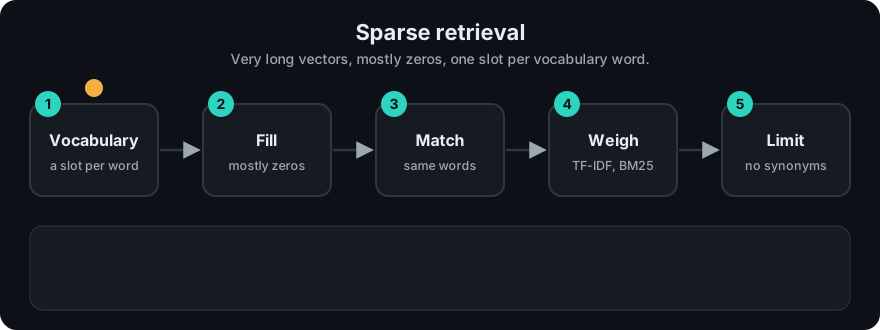
It plays on a loop. Read the caption in the box, one step at a time. Want to go at your own pace? Step through it with Previous and Next.
How it works
- Tokenize every document (lowercase, split into words, maybe remove stop words and apply stemming).
- Build an inverted index:
word → [(doc_id, count), ...]. Store document lengths too. - At query time, tokenize the query the same way.
- Look up each query word's list. Only documents in those lists can score above zero.
- Score them (TF-IDF, BM25) and return the top k.
Documents                      Inverted index
d0: "refresh token cookie"     refresh -> d0
d1: "access token short"       token   -> d0, d1
d2: "docker image layer"       cookie  -> d0
                               access  -> d1   ...
Query "token cookie": look up token -> {d0, d1}, cookie -> {d0}
score: d0 matches 2 terms, d1 matches 1 -> d0 firstTF-IDF, the older cousin of BM25: weight = tf × log(N / df). The existing code/mini_rag.py uses a TF-IDF variant with hashing (it maps words into 2,048 buckets) — a sparse retriever in a few dozen lines.
Worked example
Use the three documents from the diagram: d0 "refresh token cookie", d1 "access token short", d2 "docker image layer". The query is "token cookie".
- Look up "token" in the inverted index. It gives d0 and d1.
- Look up "cookie". It gives d0 only.
- Count matches: d0 matched both query words, d1 matched one, and d2 matched none, so d2 is never even looked at.
- Ranking: d0 first, then d1. (TF-IDF would also give "cookie" more weight than "token", since "cookie" is in fewer documents. That only strengthens d0's lead.)
Code example
An inverted index with TF-IDF scoring, stdlib only:
import math, re
from collections import Counter, defaultdict

def tokenize(text):
    return re.findall(r"[a-z0-9]+", text.lower())

docs = ["refresh token cookie", "access token short lived", "docker image layer"]
index = defaultdict(list)                     # word -> [(doc_id, tf)]
for i, d in enumerate(docs):
    for word, tf in Counter(tokenize(d)).items():
        index[word].append((i, tf))

def search(query, k=3):
    n, scores = len(docs), Counter()
    for word in tokenize(query):
        postings = index.get(word, [])
        if not postings:
            continue
        idf = math.log(n / len(postings)) + 1
        for doc_id, tf in postings:           # only touches docs containing the word
            scores[doc_id] += tf * idf
    return scores.most_common(k)

print(search("token cookie"))                 # d0 first
For BM25 scoring see code/rag_bm25.py.
In real projects (scikit-learn TF-IDF, pip install scikit-learn):
from sklearn.feature_extraction.text import TfidfVectorizer
from sklearn.metrics.pairwise import linear_kernel

vec = TfidfVectorizer(stop_words="english")
X = vec.fit_transform(docs)                   # scipy sparse matrix
scores = linear_kernel(vec.transform(["token cookie"]), X).ravel()
For production keyword search: Elasticsearch, OpenSearch, or Postgres full-text search.
When to use it / when not to
- Exact matches matter: IDs, SKUs, error codes, legal citations, names.
- You need a fast, cheap, explainable baseline with no model.
- Data has domain words embedding models have never seen.
- Not enough alone when users paraphrase or use synonyms. Pair with dense in hybrid search.
| Sparse | Dense | |
|---|---|---|
| Vector | Vocabulary-size, mostly zeros | Hundreds of dims, all non-zero |
| Index | Inverted index | ANN index (HNSW, IVF) |
| Matches | Shared words | Similar meaning |
| Explainable | Yes, which words matched | Hard |
Common mistakes
- Mixing up "sparse" with "small". A sparse vector is huge in length (one slot per word); it is just mostly zeros.
- Tokenizing queries differently from documents.
- Aggressive stop-word lists that delete meaningful words ("not", "no", or "IT" as in IT department).
- Missing stemming or lemmatization, so "tokens" never matches "token".
- Assuming sparse is "outdated". It is still a strong baseline and is often combined with dense retrieval.
Recap
If you remember only three things:
- A sparse vector has one slot per vocabulary word and is almost all zeros, so only the non-zero words are stored.
- An inverted index maps each word to its documents, so a query only touches documents that share a word with it.
- Sparse retrieval is great at exact terms but misses synonyms, so it is often paired with dense retrieval.
Interview questions
1. Why are sparse vectors called sparse? <details><summary>Answer</summary> They have one dimension per vocabulary term, so almost all values are zero for any given text. Only non-zero entries are stored. </details>
2. What is an inverted index and why is it fast? <details><summary>Answer</summary> A map from each term to the list of documents containing it. A query only touches the lists for its own terms, skipping documents that share no words. </details>
3. What is learned sparse retrieval? <details><summary>Answer</summary> A neural model (e.g. SPLADE) predicts term weights over the vocabulary, including related terms not in the text. It keeps inverted-index efficiency while adding some semantic matching. </details>
Go deeper
- Robertson & Zaragoza, The Probabilistic Relevance Framework: BM25 and Beyond — https://dl.acm.org/doi/10.1561/1500000019
- Formal et al., SPLADE: Sparse Lexical and Expansion Model for First Stage Ranking — https://arxiv.org/abs/2107.05720
Prev: BM25 · Next: Dense Retrieval · Back to phase: Phase 1