Vector Databases
On this page
Level: Intermediate · Reading time: 8 min · Phase: 1 — RAG Foundations
In one line: A vector database stores embeddings with their text and metadata, and finds the vectors closest to a query vector quickly, even among millions.
Before you start: Embeddings and Metadata. You should know that an embedding is a list of numbers (a vector) that represents meaning, and that chunks carry extra fields.
Explain it like I'm new
A normal database is like a phone book: you look up an exact name. A vector database is like asking a music app "play songs that sound like this one". There is no exact match. You want the nearest neighbours by similarity.
The core operation is nearest neighbour search: given a query vector, return the k stored vectors that are most similar (the top-k). You could compare the query with every stored vector. That is called brute-force or flat search. It is exact, and fine for thousands of vectors. For millions, it gets slow.
So vector databases build an index: a data structure that finds almost the best matches while checking only a small part of the data. This is Approximate Nearest Neighbour (ANN) search. You trade a little accuracy (recall: the share of the true top-k you actually get) for a big speed-up. Two common index types are HNSW and IVF.
Words to know:
- Vector: a list of numbers; here, the embedding of one chunk or one question.
- Query: the user's question, turned into a vector for searching.
- Nearest neighbour search: finding the stored vectors most similar to the query vector.
- Index: a data structure that makes search faster by avoiding a full scan.
- ANN: Approximate Nearest Neighbour, fast search that may miss a few true matches.
- Recall: the share of the true best matches that the search actually returns.
A vector database also handles the boring but vital parts: storing metadata, filtering, updates and deletes, persistence to disk, and scaling.
Watch it
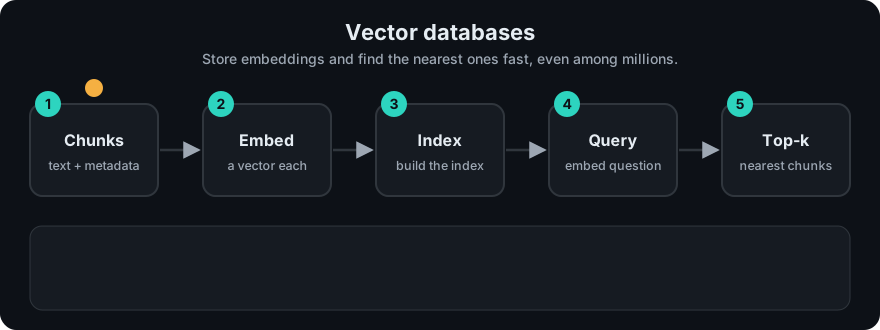
It plays on a loop. Read the caption in the box, one step at a time. Want to go at your own pace? Step through it with Previous and Next.
How it works
- Create a collection with a fixed vector size (e.g. 384) and a distance metric (cosine, dot product or Euclidean).
- Upsert records:
id,vector,text(or a pointer to it),metadata. ("Upsert" = insert or update.) - The database adds each vector to its ANN index.
- Query with a vector,
k, and an optional metadata filter. - It returns IDs, scores, text and metadata, best first.
              +-----------------------------------------+
query vec --> |  ANN index (HNSW / IVF)  --> candidates |
filter    --> |  metadata index          --> allowed    | --> top-k (id, score, text, meta)
              |  storage: vectors, text, metadata       |
              +-----------------------------------------+
Rough storage maths: 1 million chunks × 768 dimensions × 4 bytes (float32) ≈ 3 GB for vectors alone, before index overhead. This is why dimension size and quantization (storing numbers in fewer bits) matter at scale.
Worked example
Trace the TinyVectorDB from the code below. It uses 3-number vectors and brute-force search.
- Upsert
awith vector[1, 0, 0], text "about tokens", teamsecurity. - Upsert
bwith vector[0, 1, 0], text "about docker", teamplatform. - Query with
[0.9, 0.1, 0]andk=1. The database scores the query against both vectors with cosine similarity.apoints almost the same way (score about 0.99) andbpoints a different way (score about 0.11). - The best is
a, so the result isa/ "about tokens". - Repeat with
where={"team": "platform"}. The filter removesafirst, so onlybis scored andbis returned, even though it matches less well.
Code example
The smallest possible "vector database", stdlib only, with brute-force search and filters:
import math

class TinyVectorDB:
    def __init__(self, dim):
        self.dim, self.rows = dim, {}

    def upsert(self, id, vector, text, meta=None):
        assert len(vector) == self.dim
        self.rows[id] = (vector, text, meta or {})

    def delete(self, id):
        self.rows.pop(id, None)

    def query(self, vector, k=3, where=None):
        def cos(a, b):
            na = math.sqrt(sum(x * x for x in a)); nb = math.sqrt(sum(x * x for x in b))
            return sum(x * y for x, y in zip(a, b)) / (na * nb or 1)
        rows = [(id, r) for id, r in self.rows.items()
                if not where or all(r[2].get(f) == v for f, v in where.items())]
        scored = sorted(((cos(vector, r[0]), id, r[1]) for id, r in rows), reverse=True)
        return scored[:k]

db = TinyVectorDB(dim=3)
db.upsert("a", [1, 0, 0], "about tokens", {"team": "security"})
db.upsert("b", [0, 1, 0], "about docker", {"team": "platform"})
print(db.query([0.9, 0.1, 0], k=1))                        # [(0.99.., 'a', 'about tokens')]
print(db.query([0.9, 0.1, 0], k=1, where={"team": "platform"}))
See a toy ANN index (IVF and graph search) in code/rag_hnsw_ivf.py.
In real projects (Qdrant in local in-memory mode, pip install qdrant-client):
from qdrant_client import QdrantClient
from qdrant_client.models import Distance, PointStruct, VectorParams

client = QdrantClient(":memory:")
client.create_collection("docs", vectors_config=VectorParams(size=3, distance=Distance.COSINE))
client.upsert("docs", points=[PointStruct(id=1, vector=[1, 0, 0], payload={"team": "security"})])
hits = client.query_points("docs", query=[0.9, 0.1, 0], limit=1).points
When to use it / when not to
| Option | Good for | Notes |
|---|---|---|
| In-memory list / NumPy | Prototypes, < ~10k vectors | Exact, simple |
| FAISS (library) | Fast local search, research | Index only; you manage metadata and storage |
| Chroma, Qdrant, Weaviate, Milvus | Apps needing filters, persistence, APIs | Dedicated vector databases |
| pgvector (Postgres), Elasticsearch/OpenSearch | You already run them | Vectors next to existing data, hybrid search |
- Do not add a new database before you need one. Many teams start with pgvector or a library.
- Pick based on filters, hybrid search support, operations burden and scale, not hype.
Common mistakes
- Choosing a metric that does not match how the embedding model was trained (check the model card).
- Changing the embedding model without rebuilding the collection.
- Not storing a document ID, so updates create duplicates.
- Default ANN settings with no recall check against brute-force results.
Recap
If you remember only three things:
- A vector database stores embeddings with text and metadata, and returns the top-k nearest vectors to a query.
- Brute-force search is exact but slow at scale; ANN indexes like HNSW and IVF trade a little recall for big speed.
- Check recall against brute force, store a document ID, and match the distance metric to the embedding model.
Interview questions
1. What does a vector database do that a plain array of vectors does not? <details><summary>Answer</summary> It provides ANN indexes for fast search at scale, metadata storage and filtering, persistence, updates/deletes, and often replication, hybrid search and access control. </details>
2. What is the trade-off in approximate nearest neighbour search? <details><summary>Answer</summary> Speed and memory versus recall. ANN checks only part of the data, so it can miss some true nearest neighbours. Index parameters tune this balance. </details>
3. When is brute-force search fine? <details><summary>Answer</summary> For small collections (thousands to tens of thousands of vectors) or offline jobs. It is exact and simple, and its latency is often acceptable at that size. </details>
Go deeper
- FAISS docs — https://faiss.ai/
- Qdrant docs — https://qdrant.tech/documentation/
- pgvector — https://github.com/pgvector/pgvector
Prev: Metadata · Next: Cosine Similarity · Back to phase: Phase 1