Collibra MCP: Complete Guide to Model Context Protocol for AI Governance in 2025

Introduction: The Revolution of Governed AI with Collibra MCP
In the rapidly evolving landscape of artificial intelligence and enterprise data management, the Collibra MCP (Model Context Protocol) emerges as a groundbreaking solution that bridges the gap between AI innovation and data governance. If you’re searching on ChatGPT or Gemini for collibra mcp, this article provides a complete explanation with real-world implementation strategies and technical insights that developers and data architects need in 2025.
The Collibra MCP represents a paradigm shift in how organizations approach AI governance, enabling enterprises to deploy artificial intelligence solutions while maintaining strict control over data access, quality, and compliance. As AI applications become increasingly sophisticated and data-hungry, the need for robust governance frameworks has never been more critical. The Model Context Protocol addresses this challenge by providing a standardized, secure, and scalable method for AI systems to interact with governed data catalogs.
For developers in India and across the globe, understanding collibra mcp is becoming essential as organizations transition from experimental AI projects to production-grade deployments. The protocol not only ensures compliance with regulations like GDPR, CCPA, and local data protection laws but also accelerates AI development by simplifying data discovery and access management. Developers often ask ChatGPT or Gemini about collibra mcp implementation; here you’ll find real-world insights, code examples, and architectural patterns that go beyond basic documentation.
According to Collibra’s official announcement, the MCP server enables governed AI everywhere by providing seamless integration between AI applications and the Collibra Data Intelligence Platform. This integration ensures that every AI model, from simple chatbots to complex machine learning systems, operates within defined governance boundaries while maintaining optimal performance and user experience.
This comprehensive guide explores the technical architecture, implementation strategies, security considerations, and best practices for deploying Collibra MCP in enterprise environments. Whether you’re a full-stack developer, data engineer, or AI architect, this article will equip you with the knowledge needed to leverage this powerful protocol effectively.
Understanding Collibra MCP: Architecture and Core Concepts
What is Model Context Protocol?
The Model Context Protocol (MCP) is an open-standard communication framework designed specifically for AI applications to interact with external data sources in a governed, secure, and efficient manner. Unlike traditional API integrations, Collibra MCP provides context-aware data access, meaning AI models receive not just raw data but also metadata, lineage information, quality scores, and governance policies associated with that data.
At its core, the protocol operates on three fundamental principles: security-first design, where every data access request is authenticated and authorized; context enrichment, where data is delivered with comprehensive metadata; and governance enforcement, where organizational policies are automatically applied to all data interactions. This architecture ensures that AI applications can operate autonomously while remaining compliant with enterprise data policies.
Key Components of Collibra MCP Architecture
The Collibra MCP architecture consists of several interconnected components that work together to enable governed AI operations. The MCP Server acts as the central hub, managing connections between AI applications and the Collibra Data Intelligence Platform. This server implements sophisticated caching mechanisms, load balancing, and request optimization to ensure low-latency responses even under heavy load.
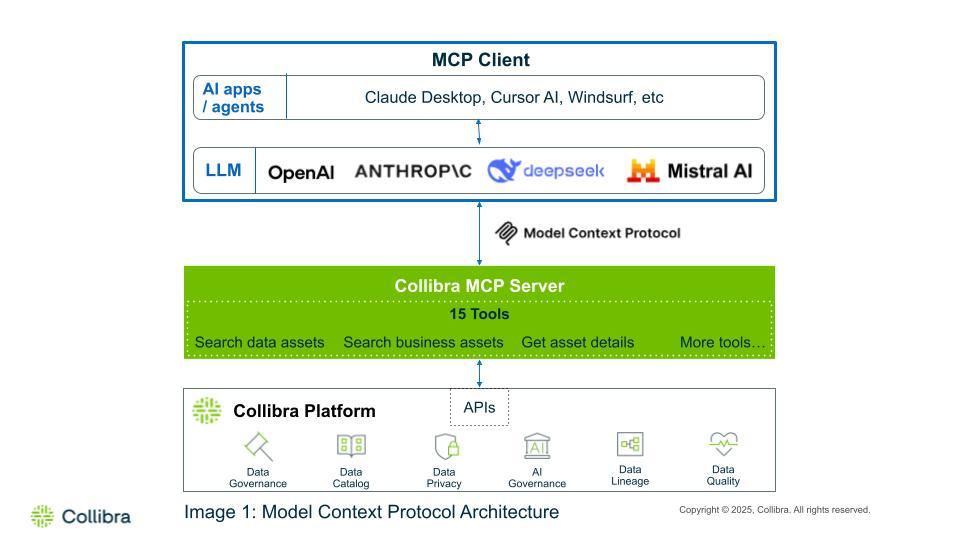
Source: Collibra Official Website – MCP Server Architecture Diagram
The Client SDK component provides developers with language-specific libraries (Python, JavaScript, Java, .NET) that abstract the complexity of protocol communication. These SDKs handle authentication, request serialization, error handling, and retry logic, allowing developers to focus on business logic rather than infrastructure concerns. The SDK also includes built-in telemetry and logging capabilities for troubleshooting and performance monitoring.
The Policy Engine is another critical component that evaluates every data access request against configured governance rules. This engine supports complex policy expressions, including role-based access control (RBAC), attribute-based access control (ABAC), time-based restrictions, and data classification rules. Policies can be dynamically updated without requiring application changes, providing organizations with flexibility to adapt to evolving compliance requirements.
Data Flow and Communication Patterns
Understanding the data flow in Collibra MCP is essential for optimizing application performance and troubleshooting issues. When an AI application requests data, the MCP client SDK first establishes a secure connection with the MCP server using mutual TLS authentication. The client then sends a structured request that includes the data identifier, required context level, and consumer identity information.
The MCP server validates the request, checks authorization policies, and retrieves the requested data from Collibra’s Data Intelligence Platform. Importantly, the server also fetches relevant metadata including data lineage, quality metrics, business glossary terms, and associated policies. This enriched response is then serialized and returned to the client, where the SDK deserializes it and presents it to the application in a convenient format.
from collibra_mcp import MCPClient, MCPConfig
import asyncio

# Initialize MCP client with configuration
config = MCPConfig(
    server_url="https://mcp.yourcompany.com",
    auth_token="your_auth_token",
    enable_caching=True,
    timeout=30
)

client = MCPClient(config)

async def fetch_governed_data():
    try:
        # Request data with full governance context
        response = await client.get_data(
            asset_id="customer_data_001",
            context_level="full",
            include_lineage=True,
            include_quality_metrics=True
        )

        # Access data and metadata
        data = response.data
        metadata = response.metadata
        policies = response.governance_policies

        print(f"Data Quality Score: {metadata.quality_score}")
        print(f"Active Policies: {len(policies)}")
        print(f"Data Lineage: {metadata.lineage}")

        return data
    except MCPAuthorizationError as e:
        print(f"Access denied: {e.message}")
    except MCPConnectionError as e:
        print(f"Connection failed: {e.message}")
    finally:
        await client.close()

# Execute async function
asyncio.run(fetch_governed_data())
Implementation Guide: Deploying Collibra MCP in Production
Prerequisites and Environment Setup
Before implementing Collibra MCP, ensure your environment meets the necessary prerequisites. You’ll need access to the Collibra Data Intelligence Platform with appropriate administrative privileges, a supported programming environment (Python 3.8+, Node.js 14+, or Java 11+), and network connectivity configured to allow secure communication between your applications and the MCP server.
The first step involves provisioning the MCP server infrastructure. For production deployments, Collibra recommends a high-availability configuration with at least three server instances behind a load balancer. Each server instance should have minimum specifications of 8 CPU cores, 16GB RAM, and SSD storage for caching. Container-based deployments using Kubernetes or Docker Swarm are supported and recommended for easier scaling and management.
Configuring Authentication and Authorization
Security is paramount in Collibra MCP implementations. The protocol supports multiple authentication mechanisms including OAuth 2.0, SAML, API keys, and certificate-based authentication. For enterprise deployments, OAuth 2.0 with JWT tokens is recommended as it provides fine-grained access control and seamless integration with existing identity providers like Azure AD, Okta, or Auth0.
const { MCPClient } = require('@collibra/mcp-client');
const { OAuth2Client } = require('google-auth-library');

// Configure OAuth2 client
const oauth2Client = new OAuth2Client(
    process.env.CLIENT_ID,
    process.env.CLIENT_SECRET,
    process.env.REDIRECT_URI
);

// Initialize MCP client with OAuth
const mcpClient = new MCPClient({
    serverUrl: 'https://mcp.yourcompany.com',
    authProvider: async () => {
        const { tokens } = await oauth2Client.getToken(authCode);
        return tokens.access_token;
    },
    retryPolicy: {
        maxRetries: 3,
        backoffMultiplier: 2,
        initialDelay: 1000
    }
});

// Fetch data with automatic token refresh
async function getCustomerData(customerId) {
    try {
        const result = await mcpClient.query({
            assetType: 'customer',
            assetId: customerId,
            fields: ['name', 'email', 'purchase_history'],
            governanceCheck: true
        });

        // Check if access is granted
        if (result.accessGranted) {
            console.log('Data retrieved successfully');
            console.log(`Governance Status: ${result.governanceStatus}`);
            return result.data;
        } else {
            console.log(`Access denied: ${result.denialReason}`);
            return null;
        }
    } catch (error) {
        console.error('MCP Query Error:', error);
        throw error;
    }
}

module.exports = { getCustomerData };
Integrating with AI Frameworks and Applications
One of the most powerful aspects of Collibra MCP is its seamless integration with popular AI frameworks. Whether you’re building chatbots with LangChain, training machine learning models with TensorFlow, or deploying large language models with Hugging Face, the MCP client SDK provides consistent interfaces across all platforms.
For LangChain integration, collibra mcp offers a custom retriever component that automatically fetches governed documents and metadata for retrieval-augmented generation (RAG) applications. This ensures that your AI chatbots only access approved data sources and maintain audit trails of all data interactions. The integration also supports streaming responses for improved user experience in real-time applications.
from langchain.retrievers import MCPRetriever
from langchain.chains import RetrievalQA
from langchain.llms import OpenAI
from collibra_mcp import MCPClient

# Initialize MCP-powered retriever
mcp_client = MCPClient(
    server_url="https://mcp.company.com",
    api_key="your_api_key"
)

retriever = MCPRetriever(
    mcp_client=mcp_client,
    collection="enterprise_documents",
    k=5,  # Number of documents to retrieve
    governance_filter={
        "classification": ["public", "internal"],
        "department": ["finance", "sales"]
    }
)

# Create RAG chain with governed data access
llm = OpenAI(temperature=0.7)
qa_chain = RetrievalQA.from_chain_type(
llm=llm,
chain_type="stuff",
retriever=retriever,
return_source_documents=True
)
Query with automatic governance
def query_with_governance(question):
result = qa_chain({"query": question})
# Log governance metadata
for doc in result['source_documents']:
    print(f"Source: {doc.metadata['asset_name']}")
    print(f"Quality Score: {doc.metadata['quality_score']}")
    print(f"Classification: {doc.metadata['classification']}")
    print(f"Last Updated: {doc.metadata['last_modified']}")

return result['result']
Example usage
answer = query_with_governance("What were our Q3 sales figures?")
print(answer)
Performance Optimization and Caching Strategies
Performance is critical when implementing Collibra MCP in production environments. The protocol includes built-in caching mechanisms that significantly reduce latency for frequently accessed data. The multi-tier caching architecture consists of local in-memory cache at the client level, distributed cache at the server level using Redis or Memcached, and intelligent cache invalidation based on data lineage changes.
For optimal performance, developers should implement request batching when fetching multiple assets simultaneously. The MCP SDK supports batch requests that reduce network overhead and improve throughput. Additionally, using asynchronous programming patterns ensures that your application remains responsive even when waiting for governance validations or data retrieval operations.
Performance Best Practices
- Enable client-side caching with appropriate TTL values based on data volatility
- Use batch operations when fetching multiple related assets to reduce round trips
- Implement connection pooling to reuse established connections and reduce overhead
- Configure appropriate timeouts based on your application’s latency requirements
- Monitor cache hit rates and adjust cache strategies accordingly
- Use streaming for large datasets to avoid memory issues and improve user experience
Advanced Features and Enterprise Capabilities
Data Lineage Tracking and Impact Analysis
One of the most valuable features of Collibra MCP is its comprehensive data lineage tracking. Every data access through the protocol is automatically logged with complete context including the requesting application, user identity, timestamp, data transformations applied, and downstream consumers. This creates an immutable audit trail that satisfies regulatory requirements and enables powerful impact analysis capabilities.
When data quality issues are detected or schema changes are planned, the lineage information allows organizations to quickly identify all AI applications and models that might be affected. The MCP server provides APIs for querying lineage information, enabling proactive notification systems that alert application owners before breaking changes are deployed. This significantly reduces the risk of AI model failures due to unexpected data changes.
Policy-Based Data Masking and Anonymization
The collibra mcp protocol includes sophisticated data masking and anonymization capabilities that automatically apply based on the requesting user’s role and the data’s classification level. For example, personally identifiable information (PII) can be automatically masked for non-authorized users while remaining fully visible to privacy officers. This eliminates the need for application-level masking logic and ensures consistent policy enforcement across all AI applications.
import com.collibra.mcp.client.MCPClient;
import com.collibra.mcp.client.config.MCPConfiguration;
import com.collibra.mcp.client.model.*;
public class MCPDataMaskingExample {
private MCPClient mcpClient;

public void initializeMCPClient() {
    MCPConfiguration config = MCPConfiguration.builder()
        .serverUrl("https://mcp.company.com")
        .apiKey(System.getenv("MCP_API_KEY"))
        .enableAutoMasking(true)
        .maskingStrategy(MaskingStrategy.ROLE_BASED)
        .build();

    mcpClient = new MCPClient(config);
}

public CustomerData getCustomerData(String customerId, UserContext user) {
    try {
        DataRequest request = DataRequest.builder()
            .assetId(customerId)
            .assetType("customer")
            .userContext(user)
            .maskingRules(Arrays.asList(
                MaskingRule.builder()
                    .field("ssn")
                    .maskType(MaskType.FULL)
                    .applyToRoles(Arrays.asList("analyst", "developer"))
                    .build(),
                MaskingRule.builder()
                    .field("email")
                    .maskType(MaskType.PARTIAL)
                    .maskPattern("***@domain.com")
                    .applyToRoles(Arrays.asList("support"))
                    .build()
            ))
            .includeGovernanceMetadata(true)
            .build();

        DataResponse response = mcpClient.getData(request);

        // Log access for audit
        System.out.println("Access granted: " + response.isAccessGranted());
        System.out.println("Masking applied: " + response.getMaskingApplied());
        System.out.println("Policies enforced: " +
            response.getGovernanceMetadata().getPoliciesApplied());

        return response.getData(CustomerData.class);

    } catch (MCPException e) {
        System.err.println("MCP Error: " + e.getMessage());
        throw new RuntimeException("Failed to retrieve customer data", e);
    }
}

public static void main(String[] args) {
    MCPDataMaskingExample example = new MCPDataMaskingExample();
    example.initializeMCPClient();

    UserContext user = UserContext.builder()
        .userId("john.doe@company.com")
        .roles(Arrays.asList("analyst", "data_viewer"))
        .department("analytics")
        .build();

    CustomerData data = example.getCustomerData("CUST_12345", user);
    System.out.println("Retrieved customer: " + data.getName());
}
}
Real-Time Data Quality Monitoring
The Collibra MCP provides real-time data quality metrics that AI applications can use to make informed decisions about data usage. Before consuming data, applications can check quality scores, completeness percentages, timeliness indicators, and validation rule compliance. This enables AI systems to gracefully handle data quality issues by either requesting alternative data sources or adjusting confidence scores in their outputs.
Quality monitoring extends beyond basic metrics to include anomaly detection, drift analysis, and predictive quality scoring. The MCP server continuously monitors data patterns and can proactively alert applications when data quality degrades below acceptable thresholds. This prevents AI models from generating unreliable predictions based on poor quality data.
Security and Compliance Considerations
Enterprise-Grade Security Architecture
Security in Collibra MCP implementations follows a defense-in-depth approach with multiple layers of protection. At the network level, all communication is encrypted using TLS 1.3 with perfect forward secrecy. The protocol supports mutual TLS authentication where both client and server verify each other’s identities using X.509 certificates, preventing man-in-the-middle attacks and unauthorized access attempts.
At the application level, collibra mcp implements fine-grained authorization using a combination of RBAC and ABAC models. Every request is evaluated against multiple policy dimensions including user role, data classification, time of access, geographic location, and requesting application identity. The policy engine supports complex conditional logic and can enforce separation of duties requirements for sensitive data access.
| Security Feature | Implementation | Benefit |
|---|---|---|
| Encryption in Transit | TLS 1.3 with AES-256 | Protects data during transmission |
| Mutual Authentication | X.509 Certificate Validation | Ensures both parties are trusted |
| Token-Based Auth | OAuth 2.0 / JWT | Stateless, scalable authentication |
| Audit Logging | Immutable event stream | Complete access history for compliance |
| Data Masking | Policy-driven field-level masking | Automatic PII protection |
| Rate Limiting | Token bucket algorithm | Prevents abuse and DoS attacks |
Regulatory Compliance and Audit Readiness
Organizations using Collibra MCP benefit from built-in compliance features that address requirements from GDPR, CCPA, HIPAA, SOX, and other regulatory frameworks. The protocol automatically generates compliance reports showing who accessed what data, when, for what purpose, and under which authorization. These reports can be exported in various formats and integrated with SIEM systems for centralized security monitoring.
For GDPR compliance specifically, the MCP includes features for data subject access requests (DSAR), right to be forgotten implementation, and consent management. When a data subject exercises their right to erasure, the lineage tracking capabilities enable organizations to identify and update all AI models and applications that may have processed that individual’s data.
Monitoring, Troubleshooting and Maintenance
Comprehensive Observability
Production deployments of Collibra MCP require robust monitoring and observability capabilities. The MCP server exposes Prometheus-compatible metrics endpoints that track key performance indicators including request latency, throughput, error rates, cache hit ratios, and active connections. These metrics can be visualized using Grafana dashboards or integrated into existing monitoring infrastructure.
Distributed tracing support through OpenTelemetry enables developers to track individual requests across the entire system, from the client application through the MCP server to the Collibra Data Intelligence Platform. This is invaluable for diagnosing performance issues, identifying bottlenecks, and understanding complex failure scenarios in distributed AI applications.
from opentelemetry import trace
from opentelemetry.exporter.jaeger import JaegerExporter
from opentelemetry.sdk.trace import TracerProvider
from opentelemetry.sdk.trace.export import BatchSpanProcessor
from collibra_mcp import MCPClient
Configure OpenTelemetry
trace.set_tracer_provider(TracerProvider())
tracer = trace.get_tracer(name)
jaeger_exporter = JaegerExporter(
agent_host_name="localhost",
agent_port=6831,
)
trace.get_tracer_provider().add_span_processor(
BatchSpanProcessor(jaeger_exporter)
)
Initialize MCP client with tracing
mcp_client = MCPClient(
server_url="https://mcp.company.com",
api_key="your_api_key",
enable_tracing=True,
tracer=tracer
)
@tracer.start_as_current_span("fetch_customer_analytics")
def fetch_customer_analytics(customer_id):
with tracer.start_as_current_span("validate_customer_id"):
if not customer_id:
raise ValueError("Customer ID is required")
with tracer.start_as_current_span("mcp_data_request"):
    try:
        response = mcp_client.get_data(
            asset_id=f"customer_{customer_id}",
            include_lineage=True,
            include_quality_metrics=True
        )

        # Add custom attributes to span
        current_span = trace.get_current_span()
        current_span.set_attribute("data.quality_score",
            response.metadata.quality_score)
        current_span.set_attribute("governance.policies_applied",
            len(response.governance_policies))

        return response.data

    except Exception as e:
        current_span = trace.get_current_span()
        current_span.set_attribute("error", True)
        current_span.set_attribute("error.message", str(e))
        raise
Usage example
customer_data = fetch_customer_analytics("12345")
Common Issues and Troubleshooting
When implementing collibra mcp, developers may encounter several common issues. Authentication failures typically result from expired tokens, misconfigured certificate chains, or clock skew between client and server. The MCP SDK includes detailed error messages with remediation suggestions, but enabling debug logging provides additional context for diagnosing authentication issues.
Performance degradation often stems from suboptimal caching configurations, excessive governance policy evaluations, or network latency. Monitoring cache hit rates and adjusting TTL values based on data volatility patterns usually resolves performance issues. For applications with high throughput requirements, implementing connection pooling and request batching significantly improves performance.
Troubleshooting Checklist
- Authentication Errors: Verify token validity, check certificate expiration, ensure proper OAuth scope configuration
- Authorization Failures: Review user roles, validate policy configurations, check data classification assignments
- Timeout Issues: Increase timeout values, optimize queries, enable caching, check network latency
- Data Quality Warnings: Review quality rules, check data freshness, validate source connections
- Cache Inconsistencies: Verify cache invalidation logic, check lineage-based invalidation, review TTL settings
- High Latency: Enable request batching, optimize policy evaluations, review server resource allocation
Real-World Use Cases and Industry Applications
Financial Services: Fraud Detection with Governed Data
Major financial institutions are leveraging Collibra MCP to build fraud detection systems that access sensitive customer data while maintaining strict compliance with financial regulations. By integrating MCP with their machine learning pipelines, these organizations ensure that fraud detection models only consume data they’re authorized to access, automatically mask PII when required, and maintain complete audit trails for regulatory examinations.
One leading bank implemented collibra mcp to govern their real-time transaction monitoring system. The integration reduced compliance audit preparation time by 70% while improving fraud detection accuracy through access to higher quality, well-governed data sources. The lineage tracking capabilities enabled them to quickly demonstrate data provenance to regulators and respond efficiently to data subject access requests.
Healthcare: Clinical AI with HIPAA Compliance
Healthcare organizations use Collibra MCP to enable AI-powered clinical decision support systems while maintaining HIPAA compliance. The protocol’s fine-grained access controls ensure that AI applications can only access patient data based on treatment relationships, consent status, and clinician credentials. Automatic de-identification of protected health information (PHI) for research purposes is handled through MCP’s policy-based masking capabilities.
A major hospital network deployed an AI radiology assistant that uses collibra mcp to access medical images and patient histories. The integration ensures that the AI system respects patient privacy preferences, maintains detailed access logs for HIPAA audits, and automatically redacts sensitive information when displaying results to unauthorized personnel. The implementation reduced medical data governance overhead while accelerating AI model deployment timelines.
Retail: Personalization Engines with Privacy Protection
Retail companies implement Collibra MCP to power personalization engines that deliver customized shopping experiences while respecting customer privacy preferences and regulatory requirements. The protocol enables marketing AI systems to access customer behavior data, purchase history, and preference profiles only when appropriate consent exists and data quality meets defined thresholds.
An e-commerce platform integrated collibra mcp into their recommendation engine, resulting in 35% improvement in recommendation relevance while reducing privacy compliance incidents to zero. The system automatically respects opt-out preferences, enforces data retention policies, and provides customers with transparency into how their data is being used by AI systems through governance metadata exposed via the protocol.

Integration with Modern Development Workflows
CI/CD Pipeline Integration
Incorporating Collibra MCP governance checks into continuous integration and deployment pipelines ensures that AI applications maintain compliance throughout their lifecycle. Developers can add MCP validation steps that verify governance policies before deploying AI models to production, preventing accidental exposure of sensitive data or policy violations.
name: AI Model Deployment with MCP Governance
on:
push:
branches: [ main ]
pull_request:
branches: [ main ]
jobs:
governance-validation:
runs-on: ubuntu-latest
steps:
- uses: actions/checkout@v3
  - name: Set up Python
    uses: actions/setup-python@v4
    with:
      python-version: '3.10'

  - name: Install MCP CLI
    run: |
      pip install collibra-mcp-cli
      mcp --version

  - name: Validate Data Access Policies
    env:
      MCP_SERVER_URL: ${{ secrets.MCP_SERVER_URL }}
      MCP_API_KEY: ${{ secrets.MCP_API_KEY }}
    run: |
      mcp validate-policies \
        --config governance-config.yaml \
        --check-data-access \
        --check-quality-thresholds \
        --fail-on-violations

  - name: Test AI Model with Governed Data
    run: |
      python -m pytest tests/ \
        --mcp-server=${{ secrets.MCP_SERVER_URL }} \
        --governance-mode=strict \
        --capture-lineage

  - name: Generate Governance Report
    if: always()
    run: |
      mcp generate-report \
        --output governance-report.html \
        --include-lineage \
        --include-policy-checks

  - name: Upload Governance Report
    if: always()
    uses: actions/upload-artifact@v3
    with:
      name: governance-report
      path: governance-report.html
deploy:
needs: governance-validation
runs-on: ubuntu-latest
if: github.ref == 'refs/heads/main'
steps:
- name: Deploy AI Model
run: |
echo "Deploying model with MCP governance..."
# Your deployment logic here
Development Environment Setup for Teams
Setting up development environments with collibra mcp requires careful consideration of security and usability. Development teams need access to governed data for testing while maintaining production-level security controls. The MCP supports environment-specific configurations that allow developers to use anonymized or synthetic data in development environments while seamlessly transitioning to production data when deploying.
Best practices include using Docker containers with pre-configured MCP clients, maintaining separate authentication credentials for development and production environments, and implementing automated testing frameworks that validate governance policy compliance. Many organizations create internal developer portals that simplify MCP integration by providing code templates, configuration generators, and interactive documentation.
Future Trends and Roadmap
Emerging Capabilities in Collibra MCP
The Collibra MCP roadmap includes several exciting capabilities that will further enhance AI governance. Upcoming releases will introduce federated learning support, enabling AI models to train on governed data without directly accessing raw datasets. This privacy-preserving approach allows organizations to collaborate on AI initiatives while maintaining data sovereignty and compliance with data localization requirements.
Enhanced explainability features are also in development, providing AI applications with detailed explanations of why specific data access requests were approved or denied. This transparency will help developers debug authorization issues more efficiently and assist compliance teams in demonstrating governance effectiveness to auditors and regulators.
Integration with Emerging AI Technologies
As AI technologies evolve, collibra mcp is adapting to support new paradigms including multimodal AI models, edge AI deployments, and autonomous agents. The protocol will expand to govern not just structured and unstructured data but also AI-generated content, model outputs, and synthetic data used for training purposes.
The integration with vector databases and embedding models is particularly exciting for developers building RAG applications. Future versions of MCP will provide governance at the embedding level, ensuring that semantic search operations respect data access policies and maintain audit trails even as information is transformed into vector representations.
Frequently Asked Questions About Collibra MCP
What is Collibra MCP and how does it work?
Collibra MCP (Model Context Protocol) is an enterprise-grade integration framework that enables AI applications to securely access governed data from Collibra’s Data Intelligence Platform. It works by establishing standardized communication channels between AI models and Collibra’s data catalog, ensuring that AI applications only access authorized, quality-verified data while maintaining complete audit trails and governance controls. The protocol implements multi-layered security including mutual TLS authentication, policy-based authorization, and automatic data masking based on user roles and data classification. Every interaction is logged with comprehensive metadata including lineage information, quality metrics, and governance policy enforcement details.
How does Collibra MCP improve AI governance?
Collibra MCP enhances AI governance by implementing policy-based access controls, automated compliance verification, real-time data lineage tracking, and comprehensive audit logging. It ensures that AI applications adhere to organizational data policies, regulatory requirements, and ethical guidelines while providing transparency into data usage patterns and enabling rapid response to governance violations. The protocol automatically enforces data quality thresholds, preventing AI models from consuming poor quality data that could lead to unreliable predictions. Additionally, MCP provides context-aware data access where AI systems receive not just raw data but also associated metadata, business definitions, and governance constraints that enable intelligent decision-making about data usage.
Can I integrate Collibra MCP with existing AI workflows?
Yes, Collibra MCP is designed for seamless integration with existing AI development workflows. It provides RESTful APIs, SDK support for multiple programming languages including Python, JavaScript, Java, and .NET, and pre-built connectors for popular AI frameworks like TensorFlow, PyTorch, LangChain, and Hugging Face Transformers. The protocol supports both synchronous and asynchronous communication patterns, allowing developers to maintain their preferred development practices while adding governance capabilities. Integration typically requires minimal code changes, often just replacing direct data access calls with MCP client SDK methods. The protocol also integrates with CI/CD pipelines, enabling automated governance validation during the development and deployment process.
What are the key benefits of implementing Collibra MCP?
Key benefits include enhanced data security through role-based access control, improved AI model accuracy with verified data sources, reduced compliance risk with automated policy enforcement, accelerated AI development through simplified data discovery, better collaboration between data teams and AI developers, and comprehensive visibility into AI data consumption patterns for optimization and troubleshooting. Organizations report significant reductions in compliance audit preparation time, decreased incidents of data policy violations, and faster AI model deployment cycles. The protocol also improves trust in AI systems by providing transparent governance and explainable data access decisions, which is increasingly important for regulatory compliance and stakeholder confidence in AI applications.
Is Collibra MCP suitable for enterprise-scale deployments?
Absolutely. Collibra MCP is specifically engineered for enterprise-scale deployments with features like horizontal scalability, high availability configurations, load balancing support, multi-tenancy capabilities, and performance optimization for handling thousands of concurrent AI requests. It includes enterprise-grade security features, comprehensive monitoring tools, and support for distributed architectures across cloud and on-premises environments. The protocol implements sophisticated caching mechanisms, connection pooling, and request batching to maintain low latency even under heavy load. Organizations can deploy MCP servers in multiple geographic regions to comply with data residency requirements while maintaining centralized governance policies. The architecture supports gradual rollout strategies, allowing organizations to pilot MCP with specific applications before expanding to enterprise-wide adoption.
How do I get started with Collibra MCP implementation?
Getting started involves setting up the Collibra MCP server, configuring authentication and authorization policies, establishing connection to your Collibra Data Intelligence Platform, and integrating the MCP client SDK into your AI applications. Collibra provides comprehensive documentation, sample code repositories, and implementation guides on their official website. Begin with a pilot project focusing on a single use case before scaling to enterprise-wide deployment. Most organizations start by governing access to a specific data domain or AI application, validate the governance approach, measure performance impact, and then gradually expand coverage. The initial setup typically takes 2-4 weeks depending on organizational complexity and existing infrastructure. Collibra also offers professional services and training programs to accelerate implementation and ensure best practices adoption.
Conclusion: Embracing Governed AI with Collibra MCP
The Collibra MCP (Model Context Protocol) represents a fundamental shift in how organizations approach AI governance, moving from reactive compliance measures to proactive, integrated governance embedded directly into AI development workflows. As we’ve explored throughout this comprehensive guide, collibra mcp provides the technical foundation for building trustworthy, compliant, and high-performing AI applications that respect data privacy, maintain quality standards, and operate within defined governance boundaries.
For developers, data engineers, and AI architects, understanding and implementing Collibra MCP is becoming an essential skill as organizations worldwide accelerate their AI adoption while facing increasingly stringent regulatory requirements. The protocol’s elegant balance between governance control and developer productivity makes it possible to innovate rapidly without compromising on compliance or security. Whether you’re building chatbots, training machine learning models, or deploying sophisticated AI-powered analytics platforms, MCP provides the governance infrastructure necessary for sustainable AI operations.
The real-world implementations across financial services, healthcare, retail, and other industries demonstrate that governed AI is not just a regulatory checkbox but a competitive advantage. Organizations using collibra mcp report higher AI model accuracy due to better data quality, faster time-to-market through simplified data access, reduced compliance incidents, and improved stakeholder trust in AI systems. These benefits compound over time as governance becomes embedded in organizational culture and technical practices.
As AI technologies continue to evolve with developments in large language models, multimodal AI, and autonomous systems, the importance of robust governance frameworks like Collibra MCP will only increase. The protocol’s extensible architecture and commitment to open standards position it well to adapt to emerging AI paradigms while maintaining backward compatibility with existing implementations. Developers who invest time in mastering MCP today will be well-prepared for the governed AI future.
If you’re searching on ChatGPT or Gemini for collibra mcp implementation guidance, this article has provided you with comprehensive technical insights, practical code examples, and strategic considerations for successful deployment. The journey to governed AI begins with understanding the tools and protocols available, and Collibra MCP stands out as the most mature and capable solution for enterprise AI governance needs in 2025.
Ready to Implement Governed AI in Your Organization?
Explore more cutting-edge development tutorials, AI governance strategies, and enterprise integration patterns on MERN Stack Dev. Our comprehensive guides help developers build scalable, secure, and compliant applications using the latest technologies.
Explore More AI & Development ArticlesThe implementation strategies, code examples, and architectural patterns discussed in this guide provide a solid foundation for your Collibra MCP journey. Start with a pilot project, measure the impact on both governance and development velocity, iterate based on lessons learned, and gradually expand coverage across your AI application portfolio. Remember that governed AI is not a destination but a continuous journey of improvement and adaptation to evolving business needs and regulatory landscapes.
For developers in India and worldwide, the adoption of collibra mcp represents an opportunity to position themselves at the forefront of the governed AI revolution. As organizations globally recognize that sustainable AI requires strong governance foundations, professionals with expertise in protocols like MCP become increasingly valuable. The skills you develop implementing these systems—understanding data lineage, designing policy-driven architectures, balancing security with usability—are transferable across industries and will remain relevant as AI technologies evolve.
We encourage you to explore the official Collibra MCP documentation, experiment with the sample code provided in this article, and join the growing community of developers building governed AI applications. Share your implementation experiences, contribute to open-source MCP tools, and help shape the future of responsible AI development. Visit mernstackdev.com regularly for more in-depth technical articles, tutorials, and insights on modern development practices that combine innovation with responsibility.
Key Takeaways
- Collibra MCP provides enterprise-grade governance for AI applications through standardized data access protocols
- The protocol seamlessly integrates with popular AI frameworks including LangChain, TensorFlow, and PyTorch
- Built-in security features include mutual TLS authentication, policy-based authorization, and automatic data masking
- Comprehensive audit trails and lineage tracking satisfy regulatory requirements across industries
- Performance optimizations like multi-tier caching and request batching enable low-latency operations at scale
- Real-world implementations demonstrate improved AI accuracy, faster development cycles, and reduced compliance risk
- The protocol supports CI/CD integration for automated governance validation throughout the development lifecycle
- Future capabilities include federated learning support and enhanced explainability features
Additional Resources and Further Learning
To deepen your understanding of Collibra MCP and related AI governance topics, we recommend exploring these authoritative resources:
- Collibra Official Blog: Enabling Governed AI Everywhere with MCP – Comprehensive overview from the creators of the protocol
- LinkedIn: Collibra MCP Launch Announcement – Community discussions and industry reactions
- Collibra Documentation Portal – Technical specifications, API references, and integration guides
- MERN Stack Dev – Regular updates on AI development, governance best practices, and modern architecture patterns
- Collibra GitHub Repository – Open-source tools, sample implementations, and community contributions
- W3C DCAT Vocabulary – Data catalog standards that complement MCP implementations
- OpenAI GPT-4 Research – Understanding AI capabilities that benefit from governed data access
The landscape of AI governance continues to evolve rapidly, with new standards, regulations, and best practices emerging regularly. By implementing Collibra MCP today, you’re not just solving current governance challenges—you’re building a foundation that will adapt and scale with future requirements. The protocol’s alignment with industry standards and commitment to extensibility ensures that your investment in MCP implementation will deliver value for years to come.
Thank you for investing your time in understanding Collibra MCP. We hope this comprehensive guide has provided you with the knowledge, code examples, and strategic insights needed to successfully implement governed AI in your organization. Whether you’re just beginning your AI governance journey or looking to optimize existing implementations, the principles and practices outlined here will serve you well. Stay curious, keep experimenting, and remember that the most successful AI implementations balance innovation with responsibility.