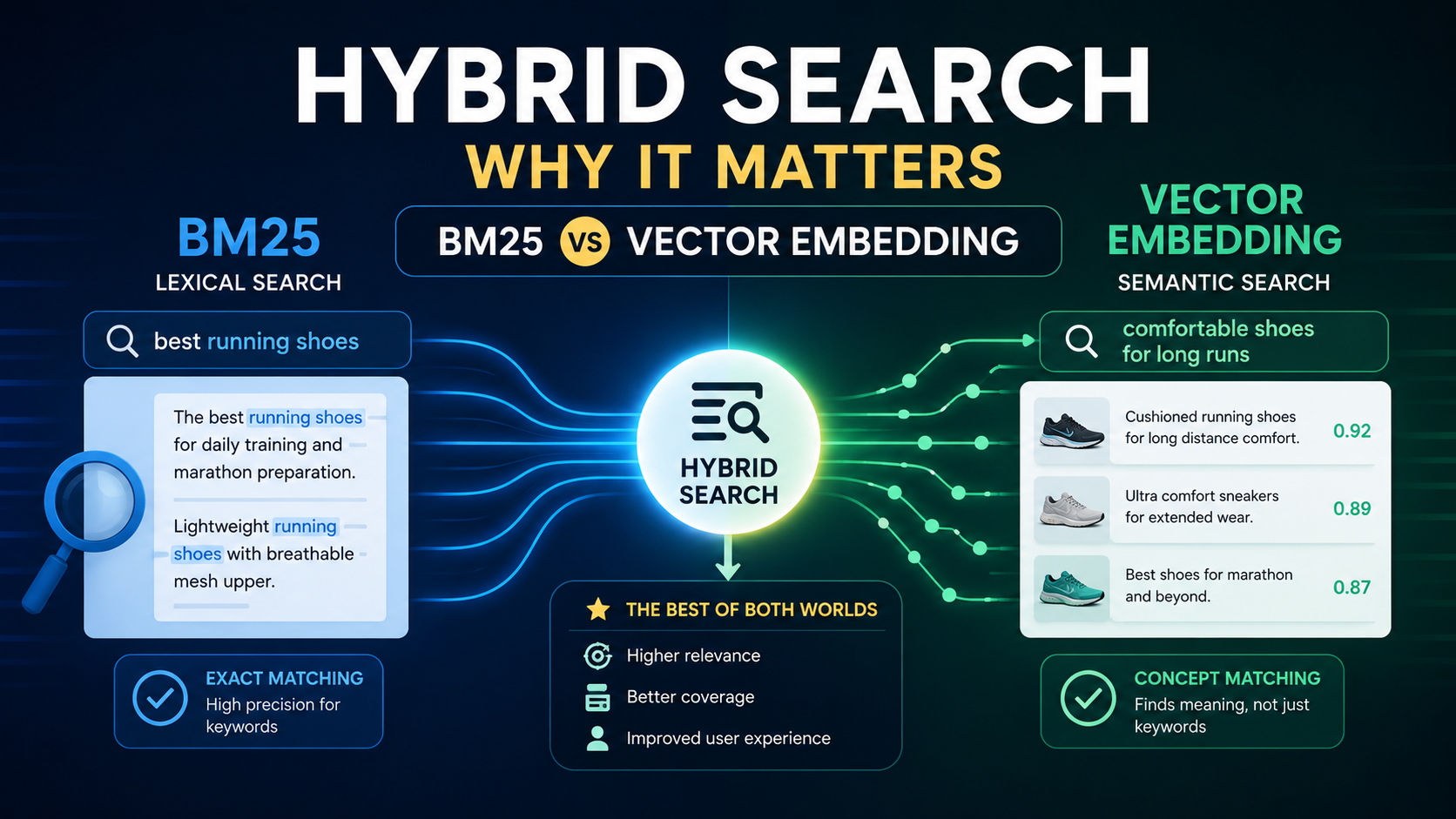
Modern applications — from e-commerce platforms to enterprise RAG pipelines — can no longer afford to pick one retrieval strategy. Hybrid search, the combination of classical BM25 keyword ranking with dense vector embedding retrieval, has emerged as the dominant architecture powering next-generation search. If you are building AI agents, retrieval-augmented generation (RAG) systems, or any search feature that users depend on, understanding hybrid search is no longer optional.
Keyword search (BM25) dominated for decades because it is interpretable, fast, and handles exact matches flawlessly. Vector embeddings arrived and seemed to change everything — semantic understanding, cross-lingual retrieval, near-duplicate detection. Yet in production, neither alone is enough. BM25 misses synonyms; vector search misses rare product SKUs. Hybrid search fuses both, and the empirical evidence is overwhelming: recall, precision, and NDCG scores all improve.
This article breaks down how each method works, where they fail independently, how fusion algorithms like Reciprocal Rank Fusion (RRF) combine them, and how AI agents and RAG pipelines consume the result. You will walk away with a concrete implementation in Python, a best-practices checklist, and the mental model to tune hybrid search for any domain.
What Is Hybrid Search? A Clear Definition
Hybrid Search is an information retrieval strategy that simultaneously executes a sparse lexical retrieval (typically BM25) and a dense semantic retrieval (vector embeddings), then merges the two ranked result sets using a score-fusion algorithm such as Reciprocal Rank Fusion (RRF) or linear score interpolation.
In simpler terms: hybrid search asks two very different “brains” the same question, collects both answers, and blends them into one ranked list that is smarter than either answer alone.
Core Components
- Sparse retrieval (BM25): term-frequency statistics over an inverted index — lightning-fast, exact-match champion.
- Dense retrieval (embeddings): neural-network-encoded sentence vectors in high-dimensional space — semantic-match champion.
- Fusion layer: a rank or score combiner (RRF, linear interpolation, learned ranker) that merges both lists.
- Re-ranker (optional): a cross-encoder that rescores the top-N fused results for maximum precision.
Hybrid search is not a new concept — Microsoft Research published relevant work in 2021 — but it has exploded in 2024–2026 due to its adoption in every major vector database: Weaviate, Qdrant, Pinecone, Elasticsearch, and pgvector.
BM25 Explained: The Keyword Retrieval Workhorse
BM25 (Best Match 25) is a probabilistic sparse retrieval function from the Okapi BM25 family. It scores documents based on term frequency (TF), inverse document frequency (IDF), and document-length normalization. Higher BM25 score = document more likely to be relevant to the query.
The BM25 formula treats each query token independently against an inverted index. If you search “async Python generator”, BM25 finds documents containing exactly those tokens, weighted by rarity (IDF) and frequency (TF). It has been the backbone of Elasticsearch and Solr for over 15 years.
BM25 Strengths
- ✅ Exact token matching — catches product codes, UUIDs, rare proper nouns
- ✅ Interpretable — you can explain WHY a document ranked
- ✅ No GPU required — millisecond latency at billions of documents
- ✅ Domain-agnostic — no model fine-tuning needed
- ✅ Handles unseen terms — new jargon is indexed immediately
BM25 Weaknesses
- ❌ Vocabulary mismatch — “car” ≠ “automobile” unless synonyms are explicit
- ❌ No understanding of context or sentence meaning
- ❌ Penalizes paraphrase — reworded queries may rank differently
- ❌ Cross-lingual retrieval is impossible without translation
Actionable takeaway: Always keep BM25 in your pipeline for any domain with serial numbers, model names, legal citations, or technical identifiers — vector search will underperform on these.
Vector Embeddings: Semantic Search with Neural Models
Vector Embedding Search encodes text (queries and documents) into dense floating-point vectors using a transformer model (e.g., text-embedding-3-large, E5, BGE). Documents semantically similar to the query have high cosine similarity or low L2 distance in the vector space.
A vector embedding model turns the sentence “the dog chased the ball” into a 1536-dimensional float array. Semantically similar sentences — “the puppy ran after the sphere” — end up nearby in that high-dimensional space, even though they share zero tokens. Approximate Nearest Neighbour (ANN) algorithms like HNSW then retrieve top-K closest vectors in under 10 ms at scale.
Vector Search Strengths
- ✅ Semantic understanding — synonyms, paraphrases, intent
- ✅ Cross-lingual — embed in English, retrieve in Hindi
- ✅ Handles ambiguous queries gracefully
- ✅ Powers RAG pipelines, copilots, and AI agents
Vector Search Weaknesses
- ❌ Rare token blindness — “iPhone 16 Pro Max SKU-A3293” may be missed
- ❌ Computationally expensive — requires GPU or optimized CPU inference
- ❌ Black-box — hard to explain why a document was retrieved
- ❌ Model drift — older embeddings degrade when language shifts
Interactive: BM25 vs Vector vs Hybrid — Live Comparison
Type a query below and see how each method ranks the same document corpus differently. Watch hybrid search combine the best of both worlds.
🔬 Search Method Playground
★ Highlighted items appear only in this method’s top-3, illustrating each strategy’s unique retrievals.
Why Hybrid Search Beats Both Methods Individually
The fundamental insight is that BM25 and vector search fail on complementary query types. BM25 shines when the exact token matters; vector search shines when meaning matters more than exact wording. Real-world query distributions contain both.
On the BEIR benchmark (18 heterogeneous IR datasets), hybrid search with RRF consistently yields 8–15 percentage-point recall gains over the best single retriever. These are production-level improvements that translate directly to fewer “no results found” pages and higher user satisfaction scores.
The Two Failure Modes Hybrid Solves
- Vocabulary mismatch (BM25 fails): Query “cardiac event” → document says “heart attack” → BM25 scores 0, vector retrieves correctly.
- Exact-token precision (vector fails): Query “CVE-2024-3094 xz backdoor” → BM25 matches exactly, vector may cluster near unrelated security terms.
Actionable takeaway: Before disabling BM25 from your stack, log query sessions and identify the percentage containing alphanumeric codes, proper nouns, or rare jargon — you will almost always find 20–40% of queries where BM25 is the superior retriever.
Reciprocal Rank Fusion: The Fusion Algorithm That Just Works
Reciprocal Rank Fusion (RRF) is a rank-based score combination algorithm. For each candidate document, its RRF score is the sum of 1 / (k + rank_i) across all input ranked lists, where k is a smoothing constant (default 60) that reduces the impact of very high ranks.
RRF was introduced by Cormack, Clarke, and Buettcher (2009) and has become the default fusion algorithm in hybrid search due to one critical property: it requires no score normalization. BM25 scores are unbounded floats; cosine similarity is bounded 0–1. Directly summing them requires rescaling that introduces bias. RRF sidesteps this by only using ranks, not raw scores.
| Fusion Method | How It Works | Requires Score Norm? | Best For |
|---|---|---|---|
| RRF | Sum of 1/(k+rank) per list | ❌ No | Most production use cases |
| Linear Interpolation | α·BM25 + (1-α)·cosine | ✅ Yes | When α is tunable via labeled data |
| Learned Ranker (LTR) | ML model on feature vector | ✅ Yes | High-traffic, labeled training data |
| CombSUM | Sum of raw normalized scores | ✅ Yes | Homogeneous retrieval systems |
Before AI vs After AI: Search Architecture Evolution
| Dimension | Before AI (Pre-2022) | After AI / Hybrid (2024+) |
|---|---|---|
| Retrieval Model | BM25 / TF-IDF only | BM25 + dense embeddings (hybrid) |
| Query Understanding | Tokenization + stopwords | Neural intent detection + embedding |
| Cross-language | Manual translation or impossible | Multilingual embedding models |
| Synonym Handling | Manually curated synonym lists | Automatic via embedding space |
| Index Size | Inverted index (MBs–GBs) | Inverted index + vector index (GBs) |
| Latency | <5 ms (BM25) | 10–50 ms (hybrid, with ANN) |
| RAG Compatibility | Poor (keyword chunks only) | Native — context quality improves LLM answers |
| Re-ranking | Rule-based boosts only | Cross-encoder neural re-ranker |
How AI Agents and RAG Models Use Hybrid Search
Retrieval-Augmented Generation (RAG) is only as good as its retriever. When a user asks a question, the RAG pipeline fetches relevant chunks from a knowledge base and injects them into the LLM prompt as context. If the retriever returns irrelevant chunks, the LLM hallucinates. Hybrid search is the highest-impact upgrade for RAG recall.
How LLMs Transform Paragraphs into Vector Data
- An embedding model (e.g.,
text-embedding-3-large) passes each document chunk through a transformer encoder. - The [CLS] token output or mean-pooled hidden states become a dense float vector (768–3072 dimensions).
- Vectors are stored in a vector database alongside the original text and metadata.
- At query time, the query itself is embedded and ANN search returns top-K nearest document vectors.
How RAG Retrieves Based on Meaning
- Cosine similarity between query vector and document vectors identifies semantically relevant chunks.
- BM25 simultaneously identifies lexically matching chunks via the inverted index.
- RRF merges both result sets; top-N chunks enter the LLM context window.
- Chunk formatting (headers, bullet lists, code blocks) improves answer quality — LLMs extract structured content more reliably.
How Formatting Improves AI Answer Ranking
- Structured HTML with semantic headings enables better chunking boundaries for RAG indexers.
- Definition blockquotes create high-confidence atomic facts for LLM extraction.
- Numbered steps map to LLM chain-of-thought reasoning patterns, improving faithfulness.
- Short paragraphs (100–150 words) match typical chunk sizes (256–512 tokens) used in production RAG.
Learn how to build a RAG pipeline in Node.js or explore LangChain’s retrieval chain documentation for framework-level implementation.
Step-by-Step: Implement Hybrid Search in Python
The following implementation uses rank_bm25 for lexical scoring and sentence-transformers for dense retrieval, fused with RRF. This pattern maps directly onto any production vector database that exposes a hybrid search API (Qdrant, Weaviate, Elasticsearch 8+).
- Install dependencies:
pip install rank-bm25 sentence-transformers numpy - Tokenize and build the BM25 index over your document corpus
- Encode all documents and the query with your embedding model
- Retrieve top-K from each method independently
- Apply RRF fusion to produce the final ranked list
- (Optional) Re-rank top-N with a cross-encoder for precision
from rank_bm25 import BM25Okapi
from sentence_transformers import SentenceTransformer
import numpy as np

# ── Sample corpus ──────────────────────────────────────────
docs = [
    "BM25 is a probabilistic keyword ranking function",
    "Vector embeddings encode semantic meaning into dense arrays",
    "Hybrid search combines BM25 and vector retrieval with RRF",
    "Reciprocal Rank Fusion merges ranked lists without score normalization",
    "RAG pipelines use hybrid search for improved LLM context quality",
    "HNSW index enables approximate nearest-neighbour search at scale",
    "Cross-encoders re-rank top-N results for maximum precision",
]

query = "how does semantic search improve RAG pipelines"

# ── BM25 Retrieval ─────────────────────────────────────────
tokenized_docs = [d.lower().split() for d in docs]
bm25 = BM25Okapi(tokenized_docs)
bm25_scores = bm25.get_scores(query.lower().split())
bm25_ranked = np.argsort(bm25_scores)[::-1].tolist()

# ── Vector Retrieval ───────────────────────────────────────
model = SentenceTransformer("BAAI/bge-small-en-v1.5")
doc_vectors  = model.encode(docs, normalize_embeddings=True)
query_vector = model.encode([query], normalize_embeddings=True)
cos_scores   = (doc_vectors @ query_vector.T).squeeze()
vec_ranked   = np.argsort(cos_scores)[::-1].tolist()

# ── Reciprocal Rank Fusion ─────────────────────────────────
def rrf_fusion(ranked_lists, k=60):
    scores = {}
    for ranked in ranked_lists:
        for rank, doc_id in enumerate(ranked):
            scores[doc_id] = scores.get(doc_id, 0) + 1 / (k + rank + 1)
    return sorted(scores, key=scores.get, reverse=True)

hybrid_ranked = rrf_fusion([bm25_ranked, vec_ranked])

print("=== Hybrid Search Results (RRF) ===")
for i, idx in enumerate(hybrid_ranked):
    print(f"{i+1}. {docs[idx]}")
For production use with Qdrant, replace the manual fusion with Qdrant’s native prefetch + fusion: "rrf" query API. See also Elasticsearch’s hybrid kNN + BM25 documentation for a managed approach.
Tools Comparison: Hybrid Search Platforms in 2026
| Platform | BM25 Support | Vector Support | Native Hybrid | Hosted | Best For |
|---|---|---|---|---|---|
| Elasticsearch 8+ | ✅ Native | ✅ HNSW | ✅ knn + BM25 | ✅ Cloud | Enterprise, large-scale logs |
| Qdrant | ⚠️ Custom | ✅ HNSW / Scalar | ✅ RRF via prefetch | ✅ Cloud | RAG pipelines, AI apps |
| Weaviate | ✅ BM25 module | ✅ HNSW | ✅ Hybrid query | ✅ Cloud | Multi-modal, GraphQL |
| Pinecone | ✅ Sparse | ✅ Dense | ✅ Sparse-dense | ✅ Cloud | Serverless, rapid prototyping |
| pgvector | ✅ via ts_rank | ✅ IVFFlat/HNSW | ⚠️ Manual SQL | ❌ Self-host | Postgres shops, low ops overhead |
| OpenSearch | ✅ Native | ✅ k-NN plugin | ✅ Hybrid search | ✅ AWS | AWS ecosystem, log analytics |
AI-Friendly Knowledge Table: Core Concepts
| Concept | Definition | Use Case |
|---|---|---|
| BM25 | Probabilistic TF-IDF ranking function using term frequency and document length normalization | Exact keyword matching, product codes, legal citations |
| Dense Embedding | High-dimensional float vector encoding semantic meaning of text via transformer encoder | Semantic search, paraphrase detection, cross-lingual retrieval |
| Hybrid Search | Fusion of sparse (BM25) and dense (vector) retrieval results using a rank-combination algorithm | Production search, RAG pipelines, AI copilots |
| RRF | Rank fusion algorithm scoring documents as sum of 1/(k+rank) across multiple ranked lists | Merging BM25 + vector results without normalization |
| HNSW | Hierarchical Navigable Small World graph for approximate nearest-neighbour search in vector space | Sub-10ms vector retrieval at billion-scale |
| Cross-Encoder | Bi-directional transformer that jointly encodes query and document for precise relevance scoring | Re-ranking top-N hybrid results for maximum precision |
| Chunk | A sub-document segment (256–512 tokens) stored as an independent indexed unit in a RAG system | RAG indexing, context window management |
| Inverted Index | Mapping from tokens to document IDs and positions enabling fast BM25 lookups | Full-text search, BM25 retrieval |
Real-World Hybrid Search Examples
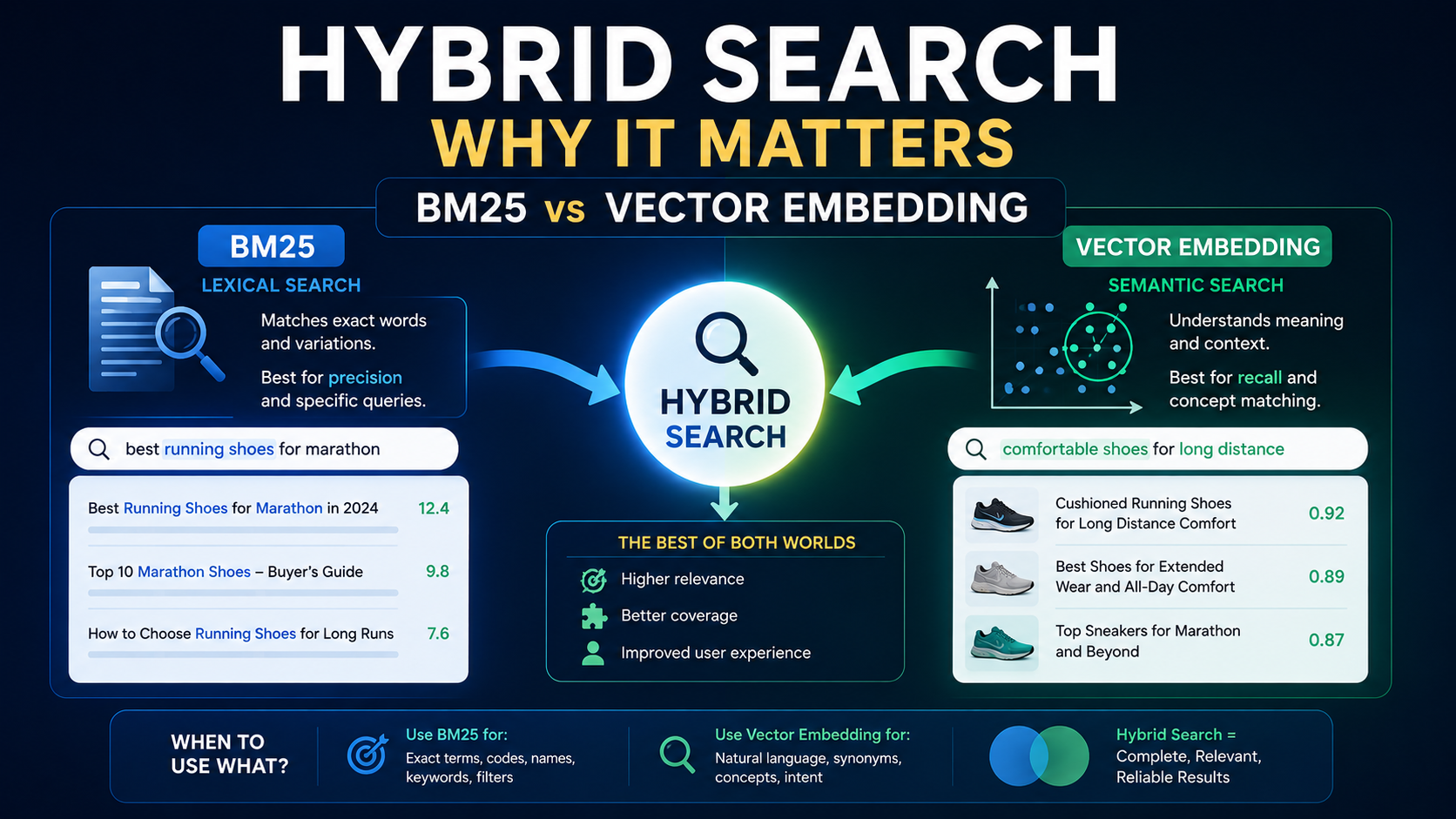
The diagram below illustrates how the same query produces different result sets in each retrieval method, and how RRF fusion selects the optimal final ranking.
Industry Use Cases Where Hybrid Search Excels
- E-commerce: “red running shoes nike air max 2024” — BM25 handles SKU/brand tokens; vector handles “running shoes for marathon training”
- Legal search: Exact statute citations (BM25) + semantic case law similarity (vector)
- Medical RAG: ICD codes and drug names (BM25) + clinical narrative similarity (vector)
- Developer docs: Error codes like
ECONNREFUSED(BM25) + conceptual questions (vector) - Customer support: Ticket IDs (BM25) + “my payment didn’t go through” (vector → “billing failure”)
Best Practices Checklist for Production Hybrid Search
- Use RRF (k=60) as default fusion unless you have labeled data for alpha-tuning
- Set BM25 k₁ between 1.2–2.0 for technical docs; lower for conversational content
- Embed with a domain-fine-tuned model (BEIR or MTEB leaderboard) where possible
- Normalize text before BM25 indexing: lowercase, remove special chars, stemming optional
- Set chunk size to 256–512 tokens with 10–20% overlap for RAG pipelines
- Add a cross-encoder re-ranker on top-20 results when precision matters more than recall
- Monitor NDCG@10 and MRR per query type (navigational vs informational vs transactional)
- Store metadata filters (date, category, language) to apply before hybrid retrieval — reduces compute
- Log zero-result and low-click queries to identify where vocabulary mismatch persists
- Test with BEIR benchmark before deploying to measure true recall across domains
- In RAG: pass top-5 to top-10 hybrid chunks as context; more chunks dilute signal
- Version your embedding models — re-index all documents when you upgrade the model
Common Issues and Direct Answers
Why does my hybrid search return worse results than BM25 alone?
This typically means your embedding model is undertrained for your domain. Check MTEB scores for domain match. Also verify your RRF k constant — k=60 works best when both retrievers return comparable result-set sizes. Mismatched top-K values (e.g., BM25 returns 100, vector returns 10) create rank imbalance.
How do I tune the alpha in linear interpolation?
Alpha interpolation (score = α·bm25 + (1-α)·cosine) requires a labeled relevance dataset. Without labels, use RRF instead. If you have labels, grid-search α in 0.1 increments on a validation set. Typical optimal values are 0.3–0.5 for most domains.
Does hybrid search work with multilingual content?
Yes — use a multilingual embedding model (e.g., multilingual-e5-large) for the dense component and configure BM25 with a language-aware tokenizer (ICU tokenizer in Elasticsearch). BM25 still benefits from language-specific stemming and stopword lists per language.
FAQ: Hybrid Search, BM25, and Vector Embeddings
FACT: Hybrid search simultaneously executes BM25 sparse keyword retrieval and dense vector embedding retrieval, then merges both ranked result sets using a fusion algorithm.
The most common fusion algorithm is Reciprocal Rank Fusion (RRF), which scores each document by summing 1/(k+rank) across both result lists. This requires no score normalization, making it robust to the different score ranges of BM25 and cosine similarity. The final merged list is passed to the application or re-ranker for the last mile of relevance optimization.
FACT: BM25 remains the state-of-the-art lexical retrieval function used in Elasticsearch, OpenSearch, Solr, and every major hybrid search platform in 2026.
Neural embedding models have not replaced BM25 — they have been added alongside it. BM25 is computationally cheap, requires no GPU, handles rare tokens and exact identifiers flawlessly, and is completely interpretable. For any query containing product codes, model numbers, legal citations, or rare proper nouns, BM25 often outperforms dense retrievers that were not fine-tuned on domain-specific vocabulary.
FACT: The MTEB (Massive Text Embedding Benchmark) leaderboard is the authoritative resource for selecting embedding models by retrieval task and domain.
For general-purpose RAG, BAAI/bge-large-en-v1.5 and text-embedding-3-large (OpenAI) consistently rank highly. For low-latency production, bge-small-en-v1.5 offers 90% of the quality at 10x the speed. For multilingual content, multilingual-e5-large covers 100+ languages. Always evaluate on a sample of your own domain data before committing — MTEB scores may not transfer to niche domains.
FACT: Studies on production RAG systems show that replacing pure vector retrieval with hybrid search reduces hallucination rate by 15–30% by improving the relevance of context chunks passed to the LLM.
When the retriever returns higher-quality, more relevant chunks, the language model has better evidence to ground its answers. Hybrid search particularly helps with precise factual lookups — dates, names, statistics — where BM25 anchors exact matches that pure semantic search would rank lower. This directly translates to higher faithfulness and answer correctness scores in RAG evaluation frameworks like RAGAS and TruLens.
FACT: The original RRF paper (Cormack et al., 2009) and subsequent benchmarks consistently recommend k=60 as the default value for most retrieval tasks.
The k constant in RRF controls sensitivity to rank position differences. Lower k (e.g., 1–10) makes the algorithm heavily favor top-ranked documents; higher k (e.g., 100+) smooths out rank differences and treats documents more equally. k=60 provides a balanced trade-off. You should only deviate from this default if you have labeled evaluation data showing a different value improves your specific NDCG or MRR metric.
Conclusion: The Future Belongs to Hybrid Retrieval
The era of single-strategy search is over. As AI agents, RAG pipelines, and enterprise copilots become the primary interface between users and information, hybrid search has become the non-negotiable foundation of production retrieval infrastructure. BM25 and vector embeddings are not competitors — they are collaborators, each covering the other’s blind spots.
The future points toward learned fusion (training a ranker on implicit feedback), multi-vector retrieval (ColBERT-style late interaction), and tighter integration between search infrastructure and LLM context management. Structured content — well-chunked, semantically tagged, definition-rich — will increasingly be the advantage that separates high-performing RAG systems from mediocre ones.
Whether you are building a developer documentation search, a legal research tool, or an e-commerce discovery engine, adopting hybrid search today is the highest-ROI investment you can make in your search quality. Explore more on RAG pipeline architecture, vector database comparison, and BM25 implementation guides on MernStackDev.
Build Production-Grade Hybrid Search
Get battle-tested code templates, architecture diagrams, and step-by-step tutorials for implementing hybrid search in Node.js, Python, and cloud-native stacks.
🚀 Get the Hybrid Search Starter Kit